
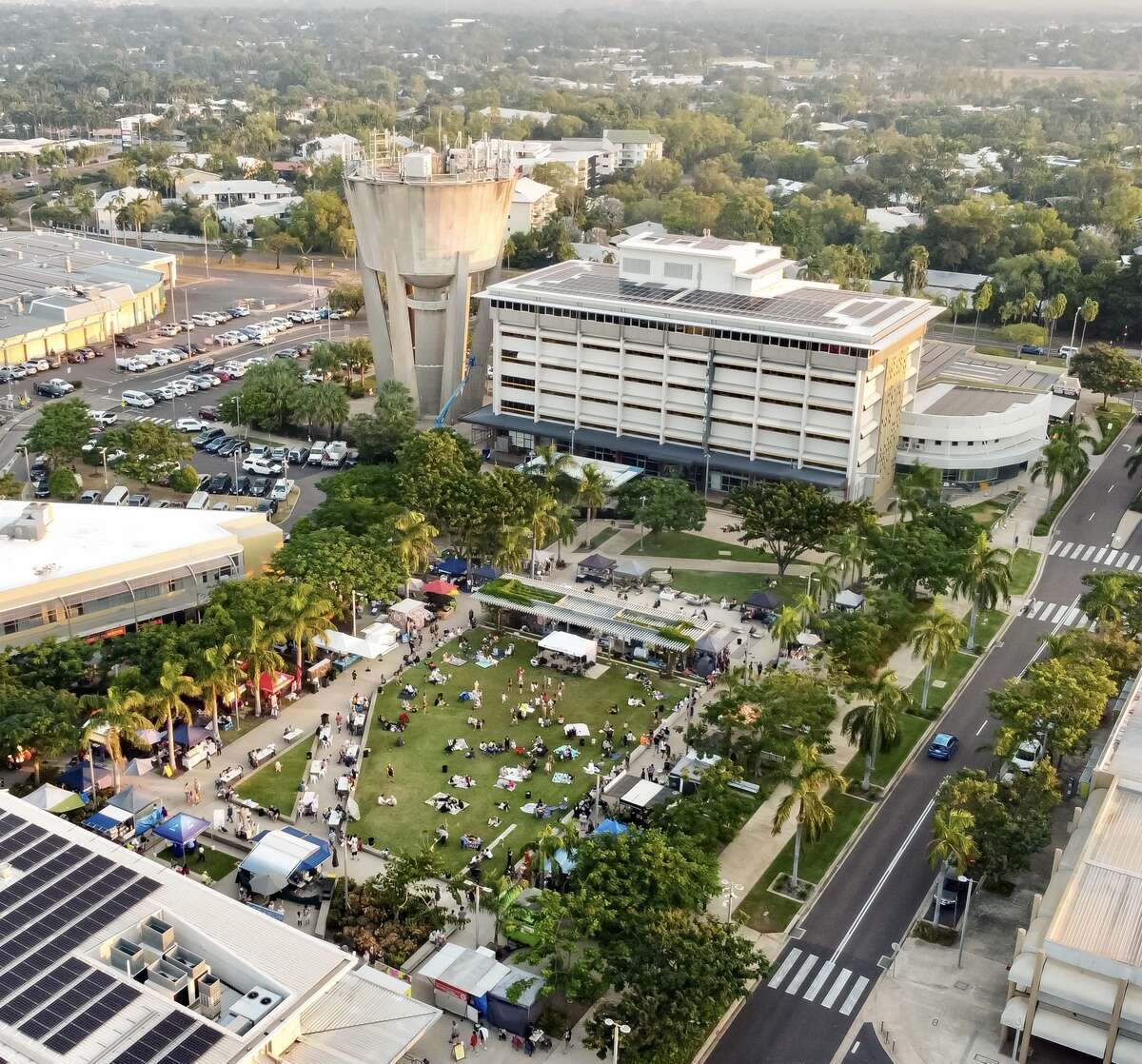
Palmerston, a sibling of Darwin, is a tropical city eager to find its own identity.
Seven years ago, the city centre was dominated by cars, indoor shopping centres, and very little community interaction.
There was no real town centre and walkability around it was non-existent.
People chose to travel between shops in their cars, instead of walking the 100 metres between Bunnings and the supermarket.
Overarching this was a dysfunctional and disconnected town.
A master plan was created by co-design leads Turf Design Studio and Hatch Roberts Day.
Through the lens of the public, the master plan sought to transform the main street and Goyder Square.
Given the uniqueness of Palmerston and the limited budget, the design team had to be creative and innovative in their design concepts; taking a piece of lawn and creating a story of connection and community.
Instead of suburban sprawl, the design team planned to capture the uniqueness of the Palmerston community with the goal of improving overall happiness.
They aspired to connect the values of the Northern Territory climate with civic life.
Rather than focus on land use, they focused on activities that would bring people into the city centre, creating an urban destination, using public spaces.
They embraced the idea of social capital as having an important role in sustainability.
Their staging plan was to not just see the delivery of more floor space but the identification of places and activities over time that would improve human happiness and a complete street approach to transport.
The master plan gave priority to people walking, cycling, and using public transport.
Through the research of urban structures and local character, the design team explored different models of density.
They didn’t want to copy big cities, so developed a hybrid model that was high/low density on a human scale with slender towns to take advantage of views, sunshine, and cooling breezes.
Overlaid by the narrative of retaining the local identity, underlying patterns to ensure legacy and memory were embedded in the master plan.
The overall approach was more evolution than reconstruction.
With the Council’s limited budget, the team focused on the recreation of a dense tropical landscape utilizing water during the wet season and sustaining itself during the dry: a low-tech approach, but highly effective in creating beautiful, welcoming landscapes.
Ultimately, this project brought a fractured community together.
It shifted from the existing model of close circuit TV surveillance to activating the town, bringing more people to the centre, and delivering safer spaces by creating places to gather, do activities, and get to know each other.
It welcomed everyone in.
This project affirms that, with community input and courage from local government and business, good urban design has the ability to transform lost, soulless spaces into attractive, green places that prioritize people and revitalize the local economy.
Project Details
Site Size – 27,000 m2
Project Budget – $7,250,000
Completion Date – 2020
Project Team
Co-Design Leads (Goyder Square Transformation)
Turf Design Studio
Turf Design Studio offers a rare depth in thinking for major development and public domain; weaving together planning, design and ecology into a vibrant tapestry – creating places that are functional, fit for living, and where the hand of the designer remains largely unseen.
Hatch and RobertsDay
Hatch and RobertsDay integration advances the planning, design, and development of urban environments worldwide.
Photography and Videography
LN Studio
LN Studio creates aerial videos.
View their work on Instagram
Photo Gallery
Click on a thumbnail image to enlarge.
Design © 2022 All Rights Reserved. Turf Design Studio and Hatch and RobertsDay | Images and Video © 2022 LN Studio. All Rights Reserved.
The Builtworks Quest
At Builtworks, we’re on a multi-year quest to document, showcase, and spotlight the best of Australia’s built environment.
That’s why we’re creating this comprehensive online archive and educational resource that showcases a diverse and eclectic range of project types and scales.
Together with showcasing older exemplars of enduring merit, we spotlight and celebrate new and recent additions to Australia’s built environment.