
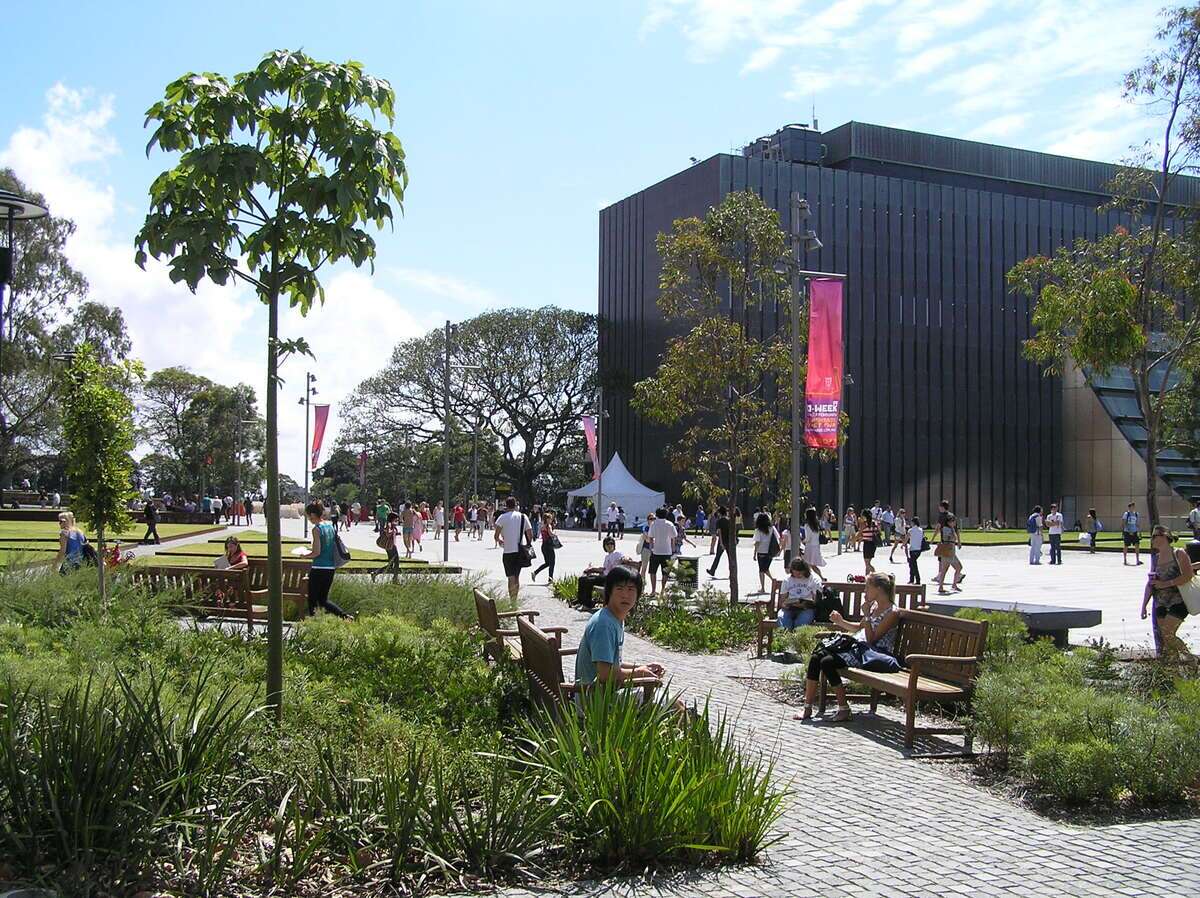
The University of Sydney was founded in 1850 as a public institution of higher education and has a vast history covering many aspects of intellectual, scientific, and socio-political life in Australia.
Its biggest campus is located at Camperdown/Darlington and comprises 72 hectares of state-of-the-art teaching and learning technology, including six libraries, art galleries, historical museums, perfectly manicured lawns, and the following faculties and schools:
- Architecture, Design, and Planning
- Arts and Social Sciences
- Business
- Engineering
- Law
- Medicine and Health
- Science
The campus is renowned for its iconic landscape of figs and jacaranda and fine buildings proudly inhabiting the ridge, looking out to Victoria Park, the City, and beyond.
Landscape architects Jeppe Aagaard Andersen (1952-2018), Tinka Sack, and Turf Design Studio won the international competition for the redevelopment of the Camperdown Public Domain.
The project intent was to create a public domain that respected what was already there whilst adding new meaning and providing for the day-to-day needs of the campus community.
Turf Design Studio was engaged as the lead consultant for landscape architecture and urban design for both the public domain and the new Law Faculty Building.
They managed and coordinated a large multi-disciplinary team of consultants from master planning through to construction.
The fundamental intent of the Turf design was to create an entirely new spirit in the centre of Sydney University, opening the University to the City, Victoria Park, and the local community by transforming a vehicular-based campus into a vibrant pedestrian precinct.
The Camperdown Public Domain now unifies an eclectic and complex University setting using a simple, functional structure generated from respect for the University’s rich cultural heritage.
The Turf design transformed a previously vehicular based campus into a distinct pedestrian district open and accessible to all Sydney pedestrians and students.
This involved relocating 410 car bays from ground level to under-ground parking.
That move, combined with the creation of a cohesive plan brought clarity to an eclectic and complex University setting.
The University buildings reflect the history of the University and the classical elements were respected in the new design.
The plan has a distinctive yet functional structure that marries the diverse spatial mix of the campus grounds.
The site and its design were treated as a medieval city like the Italian city of Mantova.
Simple grass beds and paved walkways ensure a placid environment for thinking which are also open for the lively atmosphere of University life.
Here a linear yet oblique central space creates a story line with the chronological patina of building facades, luring the pedestrian from one space to another.
The sequential spaces reveal changing personalities as the pedestrian moves through them.
The view leads.
The Ramblas of Barcelona and Havana inspire the design of the campus axis.
It follows the physical ridge of the University from Eastern Avenue to City Road and can be seen as one continuous processional.
Not all the space can be seen at once, but the axis and connection is apparent.
Encompassed within this antipodean Ramblas is the physical cadence of the campus, a structure for a diversity of rhythms, whether they be the syncopated steps of Brubeck, the variant deliberate beat found in Zappa, or the discordant harmonies of Stockhausen.
Throughout the design, trees endemic to the area are used in strong lines to create visual continuity.
Over time, the unique and sometimes capricious growth characteristics of these trees has amended and softened this precise line.
A forecourt for special events was created in front of the Quadrangle.
Classic in design, it serves as a reminder of the connection that the University has to the City of Sydney by emphasizing its position and view relative to the City.
Directly in front of the Quadrangle, granite paving extends to the refurbished garden wall, creating an elevated plaza overlooking the forecourt and beyond to the Sydney skyline.
On top of the wall, a narrow band of grass is placed to emphasize this classic line; below benches have been placed for quiet sitting.
From Manning Road to City Road, a pedestrian zone, the Ramblas, is comprised of simple robust elements that help to unify this eclectic space.
Two lines of Angophora costata (smooth-barked apple) run the length of the Ramblas integrating with significant existing trees.
The colour of their reddish trunks compliments the heritage sandstone buildings and form a canopy of overlapping branches that provide filtered light throughout the year.
At various points views and spaces open to Victoria Park and the city beyond are amplified and maintained.
Slim tall poles light the Ramblas from above while mingling with the trees’ foliage.
Raised plinths of grass are located along the promenade, containing either grass, or are planted seasonally with simple, perfumed floral displays.
A complex planting structure within the designed garden beds is arranged so that many indigenous varieties flicker past when walking along the Ramblas.
Seating is provided within the garden beds for a more private atmosphere.
Indigenous planting combined with rain and stormwater harvesting and reuse through bio-retention gardens reduces the need for supplementary watering.
The design entails robust details constructed from quality materials that are developing a rich patina and becoming more beautiful over time.
The initial budget assumed the campus was a concrete construction.
But the entire campus was built with granite within the same original budget.
Granite paving, of two different colours, unites the length of the Ramblas.
The two colours make a subtle pattern on dry days, but with rain the pattern becomes more pronounced adding dimension throughout different seasons.
The use of two slightly different tones also helps to reduce the visibility of accumulated dirt on the pavement.
Benches are placed rhythmically along the Ramblas punctuating the cadence of the campus.
Key to the project was the entry sequence to the new Faculty of Law building which needed to provide a strong visual impact from the main axis while respecting the surrounding heritage buildings by Barnet, Vernon and later, Wilkinson and Woolley.
This element has united both Darlington and Camperdown campuses, serving the needs of the local community by re-stitching a once fragmented, car-dominated university landscape.
Through a simple and legible structure generated out of respect for the university’s rich patina of heritage, the design approach was to touch lightly where significant heritage elements defined the space – sandstone walls and entry gates have been renewed and reinstated – a subtle palimpsest of its historical legacy.
The Ramblas terminates in front of the Madsen building with a water basin.
This mirror of water brings in the sky, further strengthening the central connection with a simple urban element.
It divides the Ramblas allowing for a staircase to run along its east and a ramp along its west.
Both paths connect to City Road.
In the plaza created to the west of the water basin, benches are scattered in different directions.
A ‘Kiss and Ride’ drop-off point is also created at City Road.
To the east of the Water Basin, the Ramblas opens into a plaza leading to a new footbridge.
Three fig trees were planted there – the proverbial ‘Tree of Knowledge’ – welcoming all to the University.
The design strengthened an existing pedestrian corridor, linking the northern and southern campuses, creating a processional of banded granite paving under a bold alley of Sydney Red Gums.
The inclusion of robust details and the use of quality materials ensured that a rich patina developed that will see the setting become more beautiful over time.
Views of the city are amplified and universal access has been maintained.
Water and its management are a vital component of the project.
All surface water is harvested via granite drains, tree pits, and rain gardens and then stored below ground for reuse in irrigation.
A simple basin made of granite and stainless steel, located at the main city entry, also uses the recycled water in ‘a mirror to the sky’.
Turf’s strategy in response to Sydney University’s brief was to include a series of intimate, connecting break-out spaces along the main axis that could be used for passive recreation, as well as flexible learning, and performance.
The Faculty of Law and Camperdown public domain redevelopment was a key component of the Campus 2010+ Building for the Future program.
That program was the University of Sydney’s largest capital commitment to date in transforming and renewing its Camperdown and Darlington campuses.
Dr Scott Hawken, UNSW Lecturer, Urban Development and Designn said,
The JAAA + Turf Design Studio scheme combines the timelessness of medieval European university squares and cloisters with the freshness of Sydney vegetation in a new, formal context. This has been achieved with a scheme that is dignified in both scale and detailing. It shows restraint and belies the difficulty of unifying diverse spaces.
Project Details
Project Size – 23,077 m2
Project Budget – $13,000,000
Completion Date – 2009
Project Team
Landscape Architecture
Turf Design Studio
Turf Design Studio offers a rare depth in thinking for major development and public domain; weaving together planning, design and ecology into a vibrant tapestry – creating places that are functional, fit for living, and where the hand of the designer remains largely unseen.
Photography
Simon Wood
Simon is a Sydney-based professional photographer. His extensive portfolio includes a wide range of projects specializing in architecture, landscape architecture, and design.
Ethan Rohloff
Ethan’s foundation of experience photographing the built environment from the ground carries through in a unique way to his skills as an aerial photographer.
Photo Gallery
Click on a thumbnail image to enlarge it.
Landscape Design © 2022 Turf Design Studio. All Rights Reserved.| Images © 2022 Simon Wood and Ethan Rohloff. All Rights Reserved.
The Builtworks Quest
At Builtworks, we’re on a multi-year quest to document, showcase, and spotlight the best of Australia’s built environment.
That’s why we’re creating this comprehensive online archive and educational resource that showcases a diverse and eclectic range of project types and scales.
Together with showcasing older exemplars of enduring merit, we spotlight and celebrate new and recent additions to Australia’s built environment.