
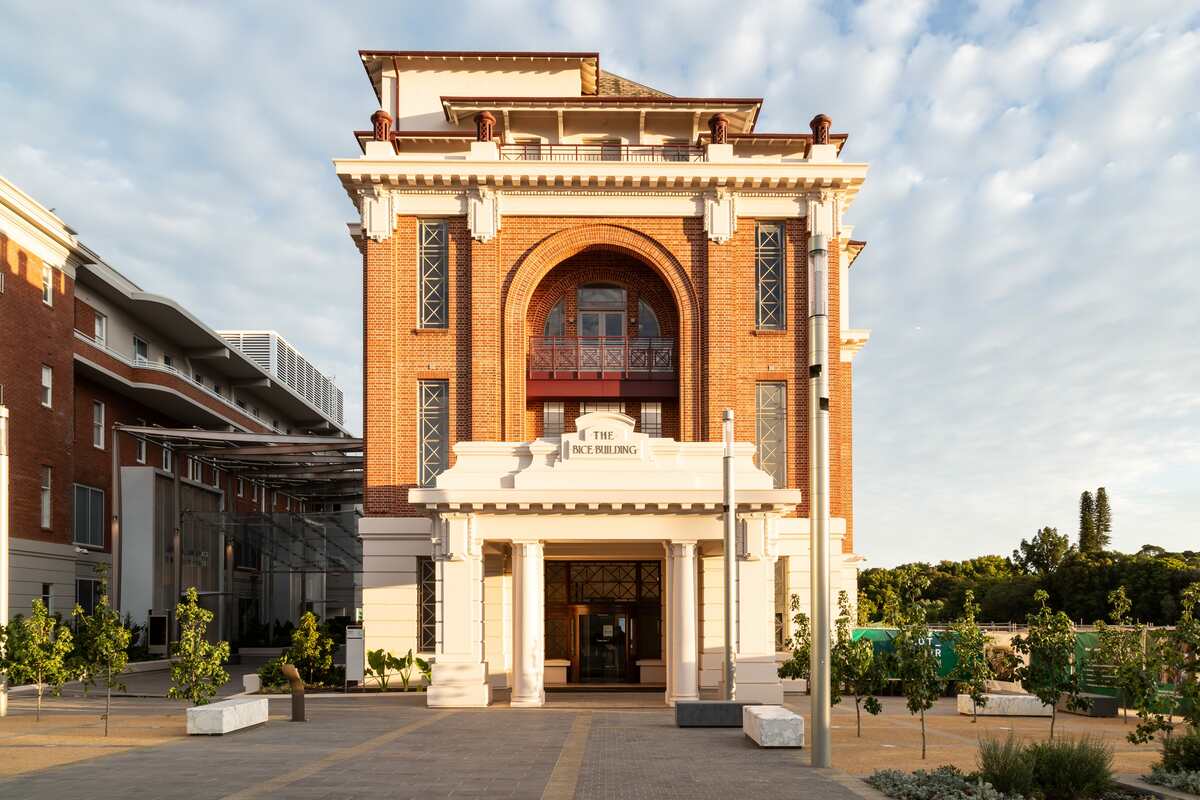
Forming part of the gateway to Adelaide’s Lot Fourteen development, the Bice Building is the last of the buildings arising from the 1921-22 masterplan for the Royal Adelaide Hospital and is included in the State Heritage Place to be refurbished.
Completed in 1927 and attributed to architect George Gavin Lawson, it originally housed ancillary hospital functions including offices, meeting rooms, accommodation, and recreation spaces for residential medical officers and a large ward on the top floor.
The refurbishment project reveals, embraces, and preserves the essence and fabric of the 1920s building and provides an engaging workplace in its new, ambitious, vibrant Lot Fourteen context.
The heritage integrity of the prominent Edwardian Classical Freestyle building was compromised by previous alterations, principally in the late 1950s and 1980s.
Inheriting a building subject to substantial internal and incompatible external change, the design strategy focussed upon value-for-money and complementary architectural intervention to enable distinction between retained, altered, and new.
These non-significant additions were removed as part of a pre-construction package of works.
Refurbishment of the four-storey Bice Building comprises prioritized base-building conservation and contemporary cold-shell fit-out that complements and preserves its key heritage attributes.
The project delivers Renewal SA’s vision to accommodate industries of the future, creating a seamless digital and physical environment across the repurposed heritage building.
Purcell, the international heritage consultants, worked on the project as part of a HASSELL and Baukultur co-led design team.
The Purcell design team initially undertook a dilapidation survey and condition report and provided heritage consultancy advice to help develop an optimal layout for future digital tenants while balancing the need to work and upgrade the existing heritage fabric.
Inheriting a building subject to substantial internal change, the design strategy focused on complementary architectural intervention, providing a distinction between retained, altered, and new.
After completing an impact assessment to assist achieve planning consent, Purcell continued to support the design team through heritage coordination and interface advice, documentation of identified priority base-building, and heritage repair works from the condition report, which formed part of the building consent, main works tender, and construction contract.
Through construction (during the COVID-19 pandemic), the Purcell design team remotely supported works implementation through quality and technical review, with limited site attendance.
Conservation and sympathetic adaptive re-use of the compartmentalized and heavily altered building into a high-performing creative and collaborative workplace was the core heritage-related challenge of this project.
A further significant challenge of the refurbishment was the structural upgrade, required for seismic code compliance.
To achieve this, a structural concrete core was inserted through the four-floor levels originally occupied by service spaces.
This relatively economic solution also provided additional space above the new toilets on each floor to discreetly accommodate the new mechanical plant, all within the existing building envelope and constructed from within.
Inheriting a building subject to substantial internal change, the design strategy focussed upon complementary architectural intervention providing a distinction between retained, altered, and new.
By understanding the original design intent, preserving significant fabric to strategic locations, and working with current layouts, the size and flexibility of the floor plates were able to be optimized for new tenants.
The project both preserves and sustains significant heritage building fabric and supports the sustainment of traditional construction trades and techniques.
Substantial external conservation works to heritage significant fabric to ensure its future use included repair, reconstruction, and restoration of the face-brick and render of the building’s four facades; repair and re-glazing of metal frame windows, and repair and reinstatement of timber frame windows to historic detail, using salvage elements from within the building.
The multi-leaf brick walls and concrete flooring throughout Bice enabled extant thermal mass to assist maintain thermal comfort levels.
Access to daylight and natural ventilation and open-air balconies/verandahs, a key element of the original design intent to allow patients access to natural light, is supplemented by new mechanical and electrical services.
To the south elevation, metal frame balustrades to historic detail, with compliant barriers designed to discreetly sit behind, were reinstated to re-activated (original) balconies.
Computer building simulation was used to optimize new glazing and minimize external shading interventions to reduce thermal loads while maximizing daylight.
The most intact internal section of the building at level one received repair and renewal of finishes, decorative ceilings, historic joinery, and lead-light windows, enabling the 1920s design aesthetic to be preserved in subtle contrast to the new fit-out.
Following an air pressure leak test, Bice achieves a 6 Star Green Star certified rating, demonstrative of how an existing, heritage building can provide a standard equal to a new building.
A combination of building techniques was employed to effect the required changes to the building including:
- Prioritized repair and restoration occurred to the face-brick and render, accepting imperfection
- Preserving as-found the patinaed elevations, focussing upon locations where the wind and water-tight envelope was compromised and where later alterations could be readily reversed to enable key heritage attributes to be reinstated.
By introducing new façade treatments where repair of previous, highly visible, and incompatible construction could be concealed and balconettes to the original east-west connecting corridor of the 1920s masterplan installed, the project incorporates value-for-money management of previous external change and original design intent to less prominent locations and provides new amenity consistent with the original design intent.
The Bice Building refurbishment project supports and recognizes the ongoing knowledge sharing between specialist consultants and contractors in the preservation of traditional construction trades and techniques.
And the preservation and adaptive reuse of heritage buildings like this one continue to be recognized as having social, historic, environmental, and economic value to the community.
The key to the successful adaptive re-use of this building was the removal of previous alterations and reinstating of original architectural elements, with a modern approach.
The project sought to conserve and reinstate much of the exterior building envelope, either to conserve original fabric or replace previous alterations in a contemporary, visually sympathetic, and complementary manner.
By working with the previously modified, original built form and optimizing the size and flexibility of the floor plates, Bice has been transformed into an innovative, collaborative, and accessible workspace, fit for the reactivated precinct for many years to come.
Analysis of the precinct context and refurbishing entry points has assisted to activate the precinct and integrate it with the public realm design.
Provision for future uses such as a café, exhibition, media, and high-tech meeting spaces will enable it to become part of the daily ritual of life at Lot Fourteen.
The project incorporates universal access to all levels of the building.
Integrating access with the public realm project to all doorways, the main entry for all users continues to be via the original, porte-cochere.
Within the state significant heritage building, equitable access to and distribution of facilities is provided, be it work location, break-out, movement between levels, balcony, kitchenette, or sanitary facilities.
The end result preserves the heritage essence of Bice and provides an engaging workplace in its new, ambitious, vibrant Lot Fourteen context.
Project Details
Project Size – 4,175 m2
Completion Date – 2021
Project Team
Lead Consultant, Architecture, and Interiors
HASSELL
Hassell brings together the best designers and thinkers in a unique collaborative process that results in both beautiful design and measurable value.
They work across architecture, landscape architecture, interior design, and urban design – a rich multi-disciplinary mix of skills and perspectives that unlocks the economic, social, and cultural value of projects.
Baukultur
Based in Adelaide, Baukultur is a recently established firm practicing architecture, interior design, urban design, and design advisory. Although new, the firm’s directors have been practicing for a long time. They offer the vitality of a start-up and the assurance of seasoned professionals – the best of both worlds.
Heritage Consultant
Purcell
Purcell is an architectural and heritage consultancy practice, employing a workforce of 250 people across UK studios in Bristol, Cambridge, Canterbury, Cardiff, Colchester, London, Manchester, Norwich, Oxford, York, and Leeds, and overseas in Hong Kong, Sydney, Melbourne, and Hobart.
Structural and Services Consultant
WSP Group
WSP believes believe that for societies to thrive, we must all hold ourselves accountable for tomorrow.
Cost Consultant
Rider Levett Bucknall
Rider Levett Bucknall (RLB) is a global independent construction, property, and management consultancy, with a team of 500 people across Australia and New Zealand.
Private Building Surveyor
Katnich Dodd
Katnich Dodd has over 20 years of building surveying experience that spans across the Private Sector and State, Federal, and Local Government Sectors.
ESD Consultant
D-Squared
Based in Adelaide, Dsquared Consulting provides Ecologically Sustainable Design (ESD) and Sustainability advice from the earliest stages of project master planning, through to building design, construction, and operation.
Superintendent
Turner and Townsend
Turner and Townsend provides cost management, project management, and program management services to clients in the real estate, infrastructure, and natural resources sectors, consulting for all levels of governments and private enterprises.
Construction
Hansen Yuncken
Hansen Yuncken is an Australian construction company, founded in 1918. The firm has successfully completed numerous landmark buildings across Australia.
Photography
Baukultur
Photo Gallery
Click on a thumbnail image to enlarge.
Design © 2022 HASSELL and Baukultur. All Rights Reserved.| Images © 2022 Baukultur. All Rights Reserved.
The Builtworks Quest
At Builtworks, we’re on a multi-year quest to document, showcase, and spotlight the best of Australia’s built environment.
That’s why we’re creating this comprehensive online archive and educational resource that showcases a diverse and eclectic range of project types and scales.
Together with showcasing older exemplars of enduring merit, we spotlight and celebrate new and recent additions to Australia’s built environment.