
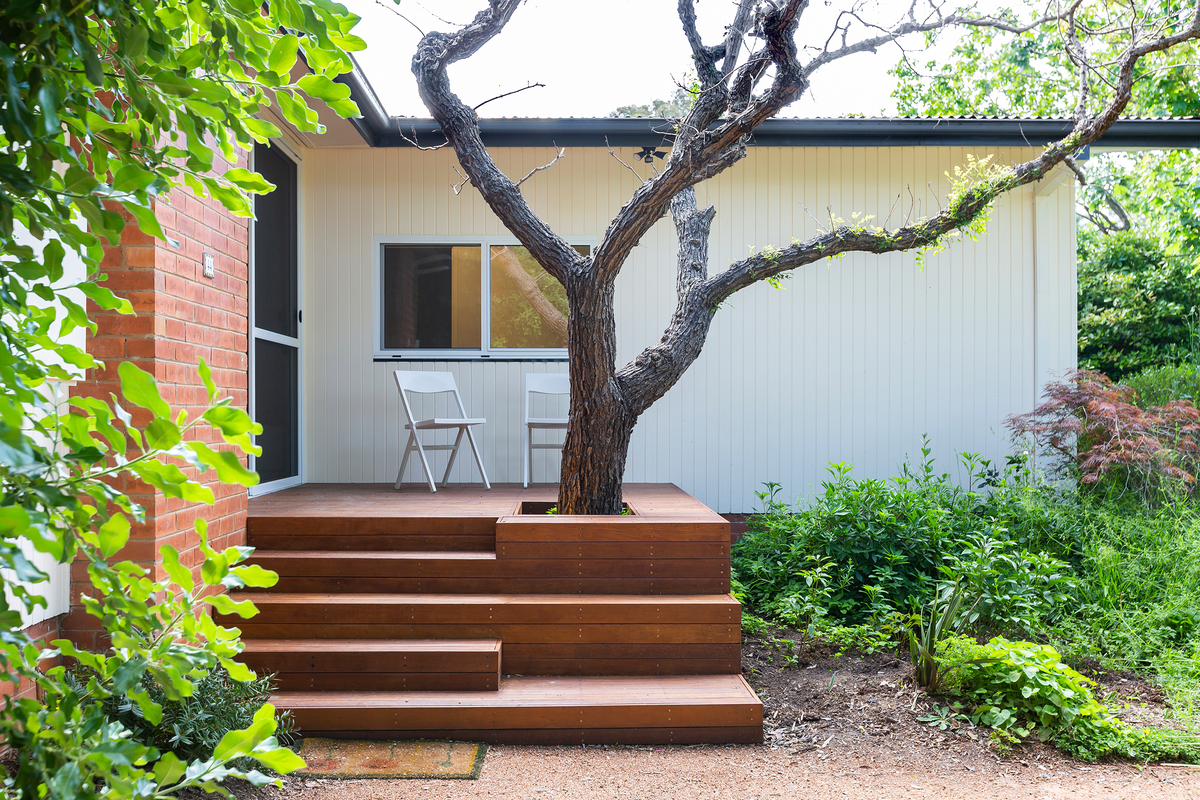
Sitting within a leafy suburban cul-de-sac of Ainslie in Canberra, Australia was an original 1960’s cottage, with good orientation to the north and a garden that would be fit for any storybook.
The house itself was a ‘T42-R unit type’ design completed by the National Capital Development Commission and had been virtually unchanged in its 57 years, with the exception of an early 00’s update to the bathroom and laundry.
The cottage had been well looked after but was in need of updating for modern family life.
Rob Henry Architects’ brief for the project was simple enough; enlarge the living space to suit a family of four and create a larger master suite whilst ensuring all spaces were well lit and connected to the front and rear gardens.
The owners also wanted to maintain the humble exterior appearance of the cottage when viewed from the street.
To meet this brief, siting of additional living space into the rear yard and tying in a new parking space and storage to replace the existing tired carport meant regulated trees and the front garden could remain untouched, and the living spaces could sit under the trees at the rear of the site.
The planning of the interior remained relatively compact.
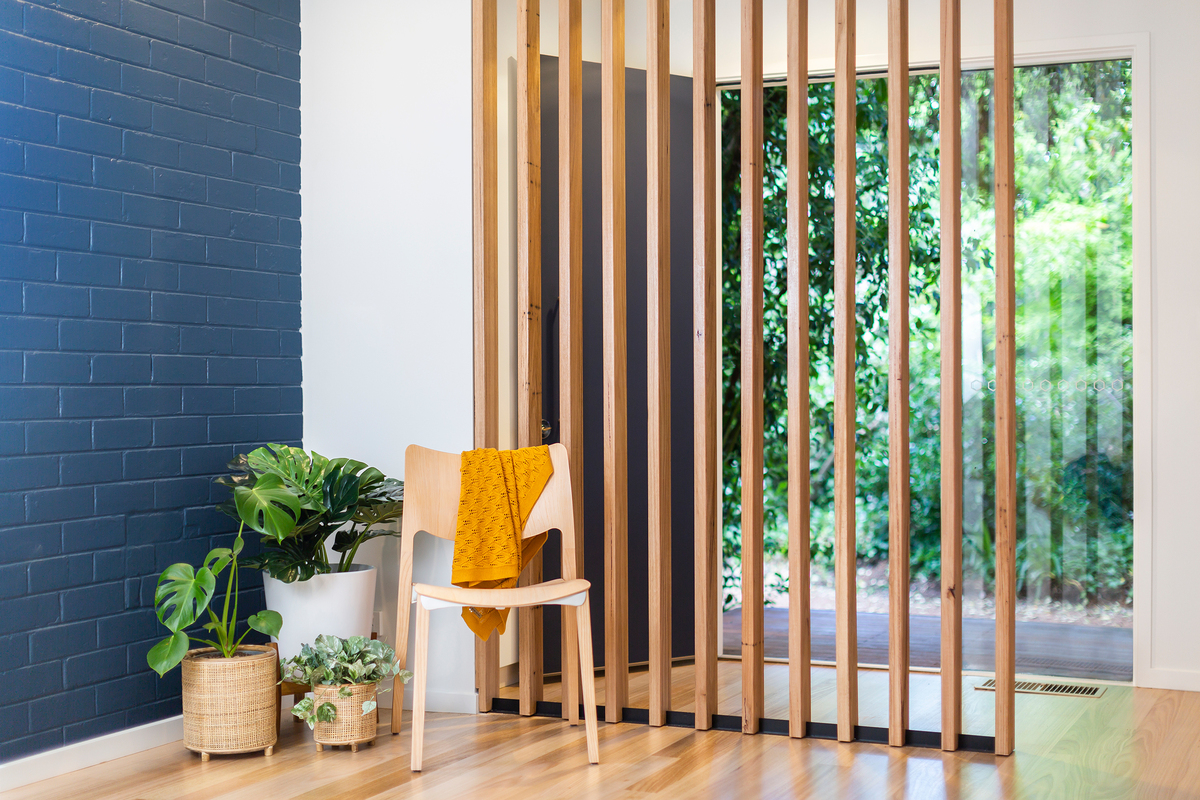
This involved reorientating the main entrance from the middle of the house where it opened onto an oversized hallway and the existing bedrooms and linking it with the driveway on the eastern side to create a clear sequence of arrival.
Where the original living spaces were located became a large dining and kitchen zone, the new layout providing a kitchen that was double the size of the existing one.
Keeping the kitchen in the same location made connecting to existing plumbing points simple, but also created a space that was surrounded on all sides.
To ensure it remained functional, walls and joinery were strategically designed to allow for circulation to both wrap the perimeter of the space and move through it.
The addition of a skylight allowed some much-needed light to penetrate the centre of the space.
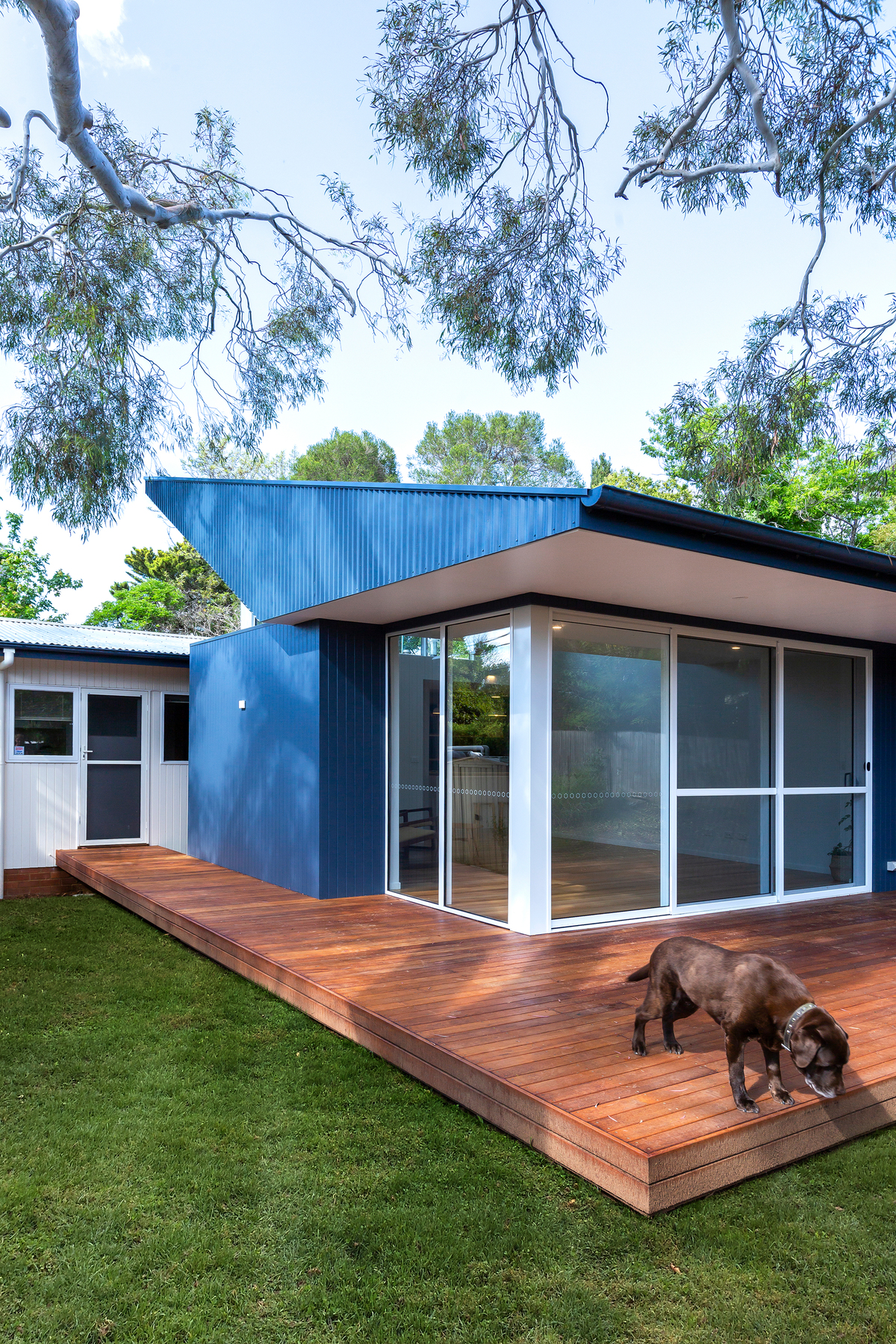
An extension to the rear allowed for new living space and master bedroom suite to connect to the backyard with access to the garden off a new deck.
While perfect in planning, this creates issues for the light quality of these spaces, as they were directly south facing.
The Rob Henry Architects team didn’t just want to tack something on the back of the existing.
They felt it was also important to ensure there was a proper separation between the old and the new.
A circulation area between the kitchen and the living and bedroom space allowed for seating at the kitchen bench and an easily accessible linen cupboard which was much needed.
Overall, the addition added an extra 64m2 of space bringing the total living area of the house to 167m2, which is still compact, but houses all requirements for the family.
With the above in mind, the design of the form had to address these issues.
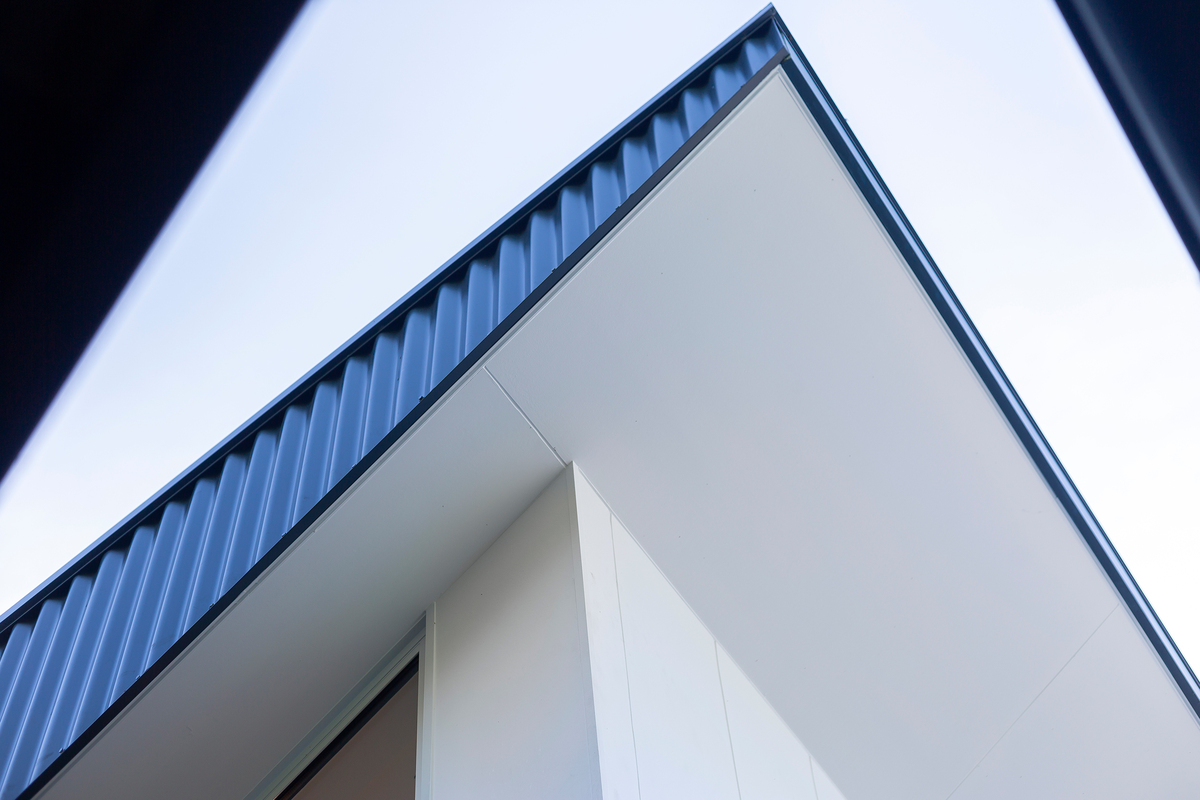
Using the finished ceiling level as a datum, we took inspiration from the existing hipped truss roof form and flipped it on its head.
Turning the truss around allowed us to do two things, it created a striking modern form that sat in juxtaposition to the original cottage, but still completed the existing lines and angles.
It also created a space to place highlight windows, directly facing north, and get much-needed light into the space from over the top of the cottage.
Adding in additional trapezoid highlight windows to each side, creating the illusion of the roof hovering behind the cottage.
The subsequent reflectiveness of the glass virtually made the addition disappear from view in the front orientation.
To ensure the light was able to reach into the master bedroom, a single piece of fixed glazing was installed above the bedroom joinery unit, allowing light to filter through into the space over the top of the ensuite, yet still ensuring the wet space was enclosed.
By doing this play in form, the most southern spaces of the entire house, have now become the most light-filled.
Taking inspiration from the cottage, the exterior cladding matches the existing, by use of lightweight V-Groove paneling and corrugated metal found on the roof.
Being unafraid of colour, Rob Henry Architects’ clients took the blue tone that was on the existing trim of the cottage, and not only painted the exterior of the addition in this tone but brought it into the house in the kitchen joinery and tiles.
By using a darker blue tone, this again assisted in the new form taking on a recessive quality to the cream-coloured cottage to the front.
Custom V-Groove paneling to selected joinery pieces throughout, took a standard piece of white joinery and elevated it, further referencing back to the style of the original.
Through construction, new insulation was added into the existing cottage, combining this by updating all windows throughout to double glazed aluminum, and further sealing ensured the home’s energy efficiency was upgraded to meet modern requirements and standards.
Through careful planning, design, and attention to detail strongly underpinned by an understanding of the site and the existing house, and all delivered with affordability, the Rob Henry Architects’ team secured the life span of this family home for another 50 years.
Project Details
Project Size – 197 m2
Site Area – 959 m2
Completion Date – 2019
Building Levels – 1
Project Team
Architecture
Rob Henry Architects
Rob Henry Architects is focused on creating architecture with an understanding of the human scale, which is both socially and environmentally sustainable.
Construction
Built by Drew
Built by Drew are builders, creators, and tradies.
Their focus is on building functional yet beautiful solutions for their client’s homes, with no complications, whether they be budget, time, or space.
Photography
Ben King Photography
Ben is a Canberra-based commercial photographer, specializing in architecture and interiors for builders, architects, interior designers, and developers.
Photo Gallery
Click on a thumbnail image to enlarge.







Design © 2021 Rob Henry Architects. All Rights Reserved.| Images © 2021 Ben King. All Rights Reserved.
The Builtworks Quest
At Builtworks, we’re on a multi-year quest to document, showcase, and spotlight the best of Australia’s built environment.
That’s why we’re creating this comprehensive online archive and educational resource that showcases a diverse and eclectic range of project types and scales.
Together with showcasing older exemplars of enduring merit, we spotlight and celebrate the very best new and recent additions to Australia’s built environment.