
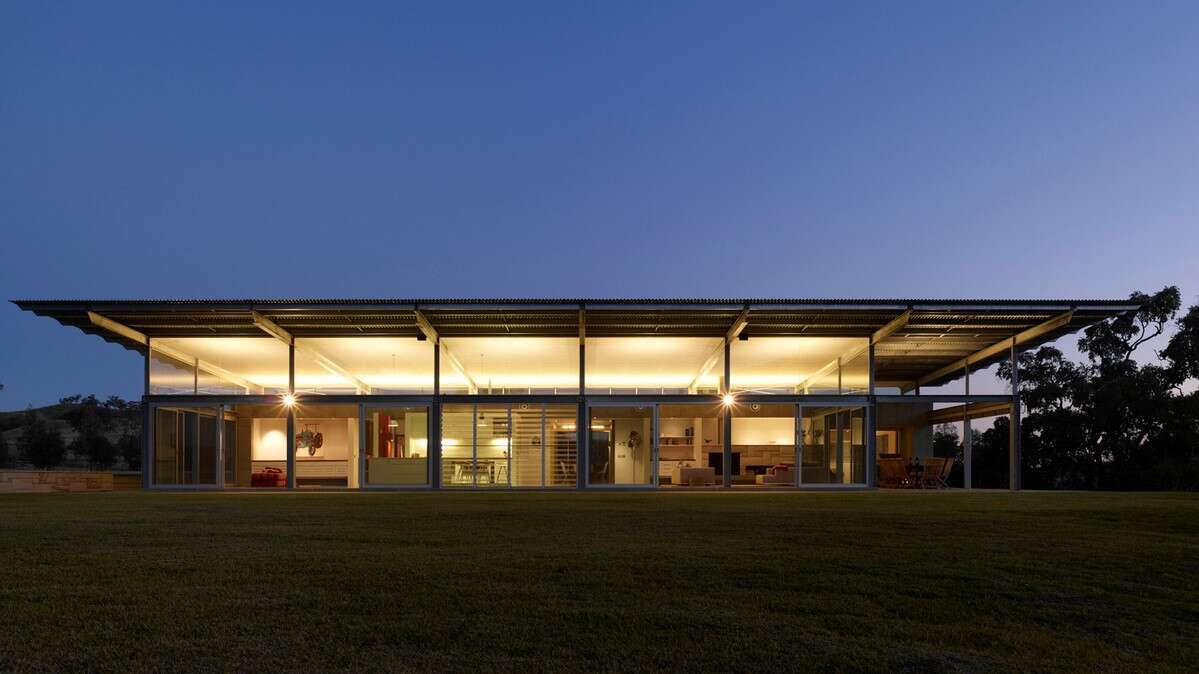
In the tradition of isolated rural buildings, Bluff Farm House was conceived by Richard Cole Architecture as a singular gesture responding to the strength of the site: a grassy north-facing terrace overlooking a river, within a spectacular valley, adjacent to an old eucalyptus tree.
The site is a rural property used for grazing cattle set amongst the beautiful undulating countryside of the Upper Hunter Valley.
It was part of a larger property owned by the current owner’s parents.
A demountable cottage was removed from the site selected for the location of the house.
The grassy terrace adjacent to the old eucalypt had traditionally been used for picnics and barbeques, and with its northern aspect and views over the river and up the valley was a natural choice for the location of the new house.
Little preparation of the site was required apart from minor levelling.
The new house was conceived by the Richard Cole Architecture design team as a holiday house that could become a primary residence in the future.
It had to be low maintenance, “walk-in / walk-out” residence with the flexibility to accommodate either a single couple or several families.
The new house they designed faces due north, with the low-pitched skillion roof opening the building to the primary views and winter solar access.
The bedrooms are located on the southern side and were perceived as rudimentary sleeping quarters, enclosed within the concrete and masonry walls.
This dichotomy of building elements was resolved in the singular gesture of the form closing down to the south and opening up to the north.
The form of the building reads as an object in the landscape: a distinct, identifiable presence like the individual trees in a Fred Williams painting.
The design evolved from an initial linear scheme along the top of the river bank to the final building form which predominantly addresses the grassy terrace and views to the north.
This evolution was a result of the clients’ input and understanding of how they have used the site and plan to use it in the future.
The essential concept of the house reflects the way in which the owner always used the place: setting up a table on the grass under the shade of the tree.
The architectural expression of the design concept was realized in the refuge of the enclosing precast concrete wall which wraps around the sleeping and service zones, and the prospect provided by the sheltering canopy steel framed roof and glazed walls which contain the living spaces.
A palette of raw materials; concrete, galvanised steel, sandstone, and plywood add texture and warmth to the interior.
The character of the building deliberately avoids artifice.
An adjacent cottage was also renovated as part of the project.
The material selection considered the necessity for longevity and durability, along with design elements that could be adapted over time.
The client had a keen interest in architecture and design and during discussions about the character of the house, referenced the Case Study Houses and architects such as Neutra, Schindler, and Kerry Hill.
The unusual use of precast concrete in a residential application was challenging yet appropriate in the rural context and proved economical.
The lightness of the galvanised steel structure contrasts the mass and weight of the precast concrete.
Materials were left naturally finished rather than painted, giving a rawness and agricultural, rather than polished tone to the building.
The building is designed using solar passive principles, with the polished concrete floor and precast walls providing high thermal mass.
Recycled Tallowood was used throughout the project for doors, exposed stud work, and joinery.
A 130,000-litre rainwater tank supplies all water needs for the site, and the large canopy roofs provide effective collection areas for this tank.
Water is heated using a solar system.
Cross ventilation is provided to all rooms, and high louvres on the south elevation below the primary floating roof effectively vents hot air from the high ceiling spaces.
A backup air conditioning system and in-slab heating is provided for extreme periods.
Retractable vental louvres protect the western facade and verandah from the low summer afternoon sun.
Solar studies were conducted to determine optimal eaves widths.
A range of lighting options is provided for each space so that the character of rooms can be adjusted for different uses.
General lighting is provided by concealed dimmable strip fluorescent battens and large uplights, while task and feature lights operate on different circuits.
Project Details
Project Size – 300 m2
Site Area – 235 ha
Completion Date – 2008
Building Levels – 1
Project Team
Architecture
Richard Cole Architecture
Richard Cole Architecture is a small design-based studio located on the Northern Beaches of Sydney.
www.richardcolearchitecture.com.au
Construction
Jeff Towler Building
The family-owned firm has been continuously operating for more than 25 years, specialising in the construction of prestige architecturally designed homes in Sydney’s eastern suburbs and the Upper Hunter Valley region.
Photography
Brett Boardman
Brett is a well-established commercial and architectural photographer based in Sydney.
Photo Gallery
Click on a thumbnail image to enlarge.
Design © 2022 Richard Cole Architecture. All Rights Reserved.| Images © 2022 Brett Boardman. All Rights Reserved.
The Builtworks Quest
At Builtworks, we’re on a multi-year quest to document, showcase, and spotlight the best of Australia’s built environment.
That’s why we’re creating this comprehensive online archive and educational resource that showcases a diverse and eclectic range of project types and scales.
Together with showcasing older exemplars of enduring merit, we spotlight and celebrate new and recent additions to Australia’s built environment.