
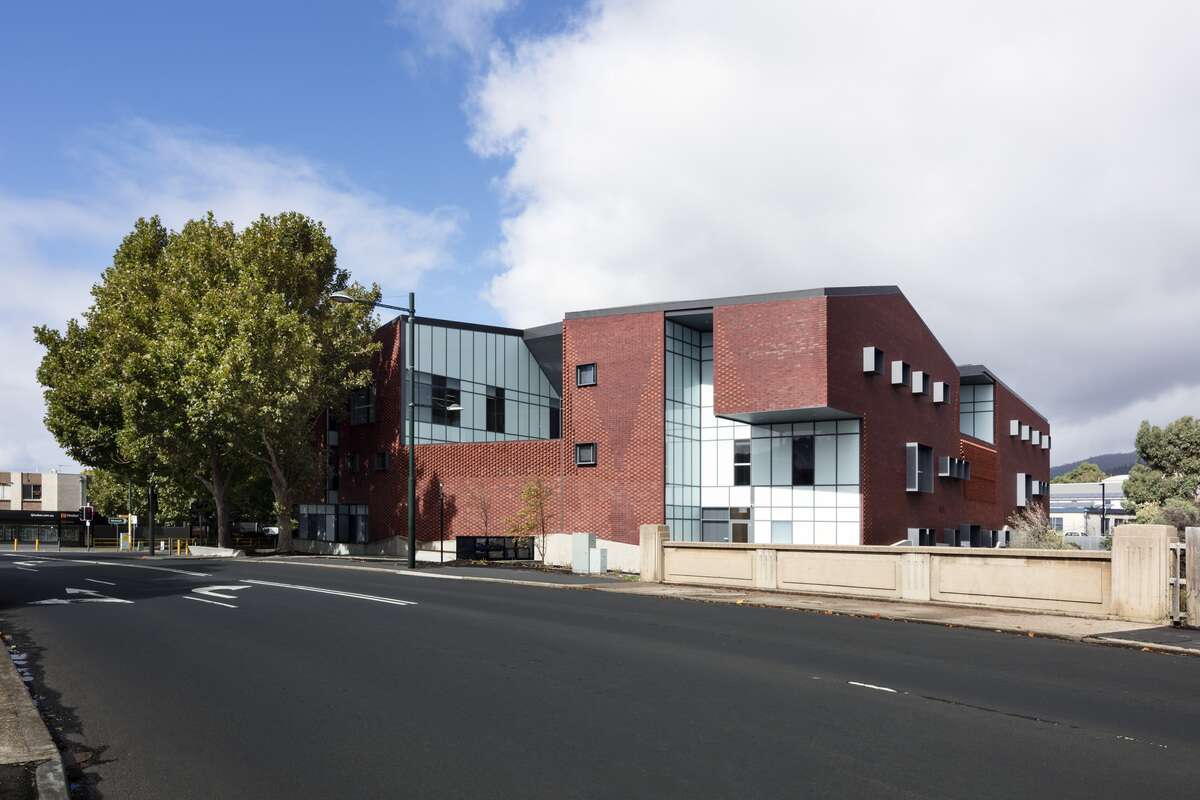
The first of its building type in Tasmania, the Glenorchy Health Centre was designed by LIMINAL Architecture in collaboration with clinical planning specialists DesignInc.
The Centre incorporates a range of integrated health services to address the diverse and increasing health demands of the suburbs just north of Hobart, Tasmania’s capital city.
LIMINAL Architecture was named Principal Consultant in 2014 and a collaboration with DesignInc, the Department of Health and Human Services, health specialists, community stakeholders, and statutory authorities has seen a health centre grow out of its community needs and its place.
Underlying the architecture is the philosophy that health care facilities should be designed to not only support and facilitate state-of-the-art medicine, technology and quality patient care, but also to embrace the patient, family, and caregivers in a socially supportive, therapeutic, and non-alienating environment.
Architecturally, the building’s form and materiality respond to converging contexts through the recognition of a civic edge, the natural edge facing Humphrey’s Rivulet, the existing heritage trees along Barry Street, and the edge facing the residential area at the foothills of Kunanyi/Mt Wellington.
Brick, the predominant external material, plays an important role in reconciling the interface between suburban and civic while responding to the vibrancy and diversity of the precinct.
LIMINAL collaborated with Austral Bricks Tasmania, to create the first carbon-neutral ‘glazed’ brick produced in Australia.
Its custom colour references the red brick of the former socially significant Child Health Association built in 1941, once occupying the site.
Working within the wire cut and clay deposit constraints of the Austral Longford plant, the collaboration resulted in two carbon-neutral red bricks (‘LIMINAL Lava’ and ‘LIMINAL Lush’) with unique, rich glazes, providing a subtle sheen and highlighting the inherent character of the textured bricks, befitting of its context.
A condition of the Glenorchy Planning Scheme at the time required that “facades of buildings on the street frontage do not create large expanses of blank wall”.
The corbelling and patterning of brickwork is a method of descaling large brick walls historically appropriate to the context.
Secondary facade systems are a combination of glazed elements, insulated panels, and framing, which contrasts to but also compliments the monumental solidity of the masonry façade.
Inside, multiple reception points throughout the building create more personalized and smaller, intimate waiting areas.
An atrium allows light to penetrate the building and access to vistas has been considered throughout as well as no ‘dead-end’ dark corridors.
The use of colour throughout the building was used as a wayfinding device.
Colour selection draws upon the therapeutic effects of nature and is offset against a predominantly neutral, calming backdrop.
The building is designed to Green-Star benchmark principles.
This includes a chilled beam system, monitored mechanical and electrical systems optimising delivery and usage, bike facilities and showers, energy-efficient fittings, and water-saving devices.
The internal materials were driven by minimising VOCs, recyclability, and a low carbon footprint principle.
Project Awards
The Glenorchy Health Centre has been recognised for excellence in design and architecture.
View the full list of awards here
The Glenorchy Health Centre is a dignified consolidation of services in the northern suburbs of Hobart, providing assistance with everything from housing to dentistry.
The modest building is stacked across three levels and wrapped in a playful masonry façade along the high street, bricks alternating like reptilian scales.
This architectural delight is something of a material nod to its suburban context.
The GHC is a work of humble architecture and the architects have delivered a volume that is just enough.
This building does what it needs to do and fits neatly into its surroundings.
It is part of a lineage of fine and unassuming Tasmanian public buildings.
Award (Public Architecture) Tasmanian Architecture Awards – 2019
LIMINAL Architecture with DesignInc has delivered a fundamentally altruistic building for an urban community.
Glazed carbon-neutral bricks were specifically developed for the project and these are the first to have been utilised in Australia.
From the big picture to the smallest details, the architects have remained focused on the principles of sustainability and for this, they are to be commended.
Commendation (Sustainable Architecture) Tasmanian Architecture Awards – 2019
Community Feedback
I would like to pass on my appreciation of the thoughtful architecture that has gone into the new Glenorchy Health Centre.
The choice of building materials ensures that it is both in keeping and respectful to the existing buildings, whilst bringing contemporary architecture and a building of real interest to the local area.
Dylan Chivers, Chief Financial and Operations Officer, Dominic College
I would like to pass on congratulations to the team after visiting the centre for the first time yesterday.
It is an amazing design, the exterior blends beautifully in the existing streetscape, I enjoyed the different textures and sculpture and view the building as a piece of art.
Pamela Gaines, community member.
Project Details
Project Budget – $15,200,000
Completion Date – 2018
Project Team
Architecture and Interior Design
LIMINAL Studio
LIMINAL Studio embraces a multi-disciplinary design approach driven by the purpose, function, and meaning of ideas-based design.
Architect Collaborator
DesignInc
DesignInc designs innovative human habitats that nurture people, reduce environmental footprints, and become cultural assets. The practice has extensive and celebrated expertise in designing healing and care environments.
Structural, Civil, and Hydraulics Engineering
Gandy & Roberts
Gandy and Roberts specialise in structural, civil, and hydraulic engineering for building projects, working with clients across a broad range of services.
Mechanical and Electrical Engineering
COVA
COVAis a national multi-disciplinary engineering consultancy with an extensive and successful track record designing complex projects and systems.
Landscape Architecture
Inspiring Place
The firm’s unique blend of skills across landscape architecture, tourism, recreation, environmental management and community engagement leads to whole systems thinking about the strategy and design for inspiring places.
Building Surveyors
Lee Tyers Building Surveyors
Lee Tyers Building Surveyors is a well-established firm of building surveyors providing building surveying services to residential, commercial, educational and government sectors throughout Tasmania.
Archaeologists
Austral Archaeology
Austral Archaeology was founded in 1987. Since that time the firm has gained a reputation for consistently high quality work throughout Australia and is now one of the country’s leading and longest-established heritage consultancies.
Construction
Hansen Yuncken
Hansen Yuncken is an Australian construction company, founded in 1918. The firm has successfully completed numerous landmark buildings across Australia.
Manufacturing Collaborator
Austral Bricks
Austral Bricks is owned by Brickworks Limited, the biggest single brickmaking company in Australia.
Photography
Dianna Snape
Dianna Snape is an Australian architectural photographer based in Melbourne, specializing in interior, landscape, and architectural photography.
Photo Gallery
Click on a thumbnail image to enlarge.
Design © 2022 LIMINAL Studio in collaboration with DesignInc. All Rights Reserved.| Images © 2022 Dianna Snape. All Rights Reserved.
The Builtworks Quest
At Builtworks, we’re on a multi-year quest to document, showcase, and spotlight the best of Australia’s built environment.
That’s why we’re creating this comprehensive online archive and educational resource that showcases a diverse and eclectic range of project types and scales.
Together with showcasing older exemplars of enduring merit, we spotlight and celebrate new and recent additions to Australia’s built environment.