

Ripple House, designed by FMD Architects, supports their clients shared and independent lives, offering atmospheres to socialise and entertain, retreat and dwell.
The reconfigured space provides additional and improved amenity, with a focus of well-being.
The gentle steps of the site are embraced, defining programme spaces while maintaining a generous sense of scale and openness.
Communal and private zones enjoy equal access to the garden, while the master bedroom’s relocation to the rear affords additional privacy and seclusion.
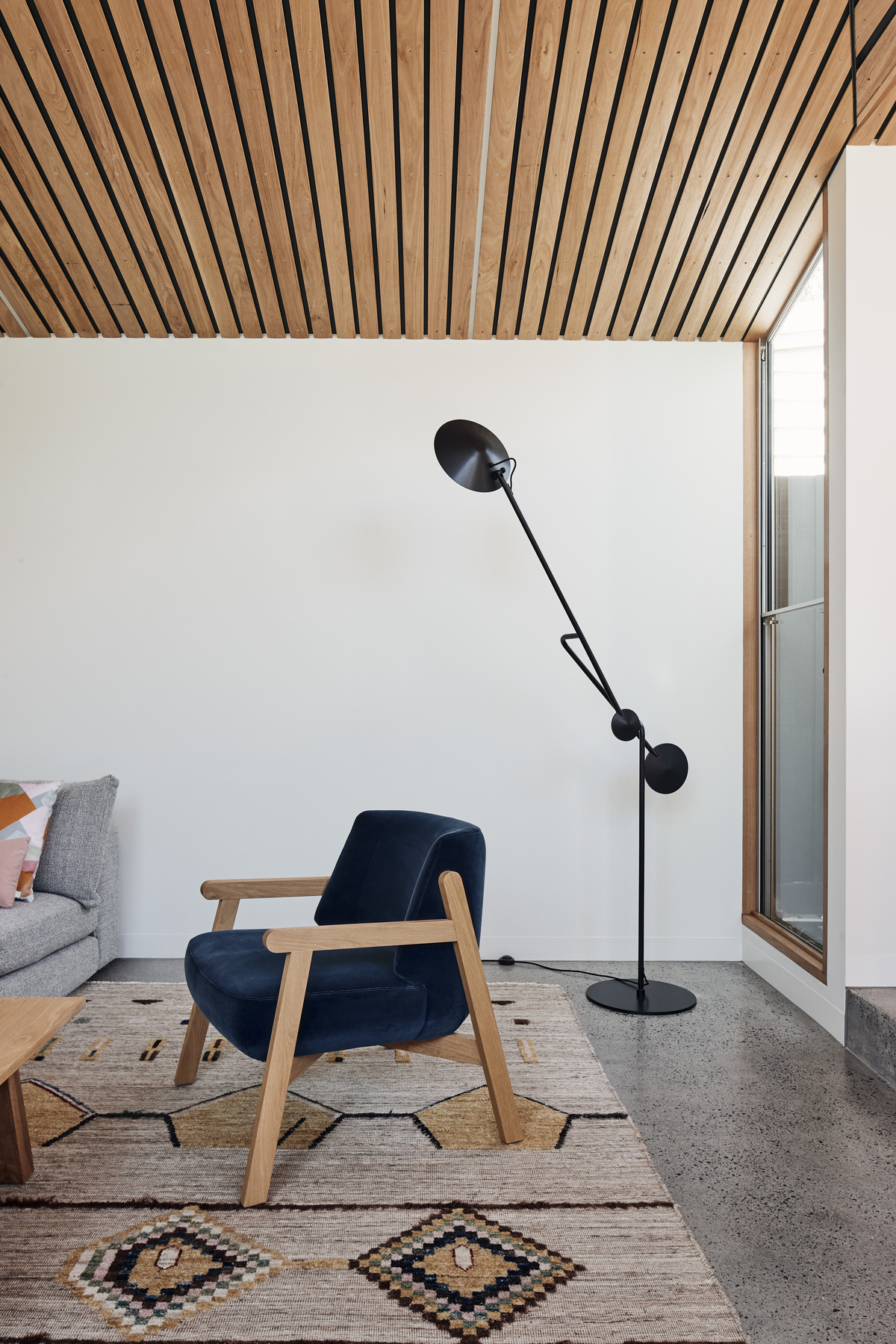
The clients’ love of Australian designed and made furniture is met with a beautiful selection of locally sourced pieces, interspersed with beloved vintage finds.
Ripple House is a series of unfurling spaces defined by subtle shifts in the site and light.
Discreetly positioned behind a single-fronted Victorian façade, this addition designed by FMD Architects reinvents the previously disconnected floorplan, creating a highly adaptable family home that’s connected to its garden.
The architecture develops a narrative around reverberation and progression, drawing on the ‘ripple’ notion to explore deft forms that mediate the descent of the site’s gentle fall and associated impact on the interior.
The traditional sequence of bedrooms is maintained as a study and guest room, while the bathroom is thoughtfully re-worked.
The junction of old and new is marked by a change in floor level and finish – from timber to concrete, with a lowered ceiling saturated in deep green.
Kitchen cabinetry is recessive with crisp white finishes, juxtaposed with sculptural ply forms.
The island bench has broad proportions with forms responding to the rippling ceiling, creating an intuitive gathering area for informal entertaining.
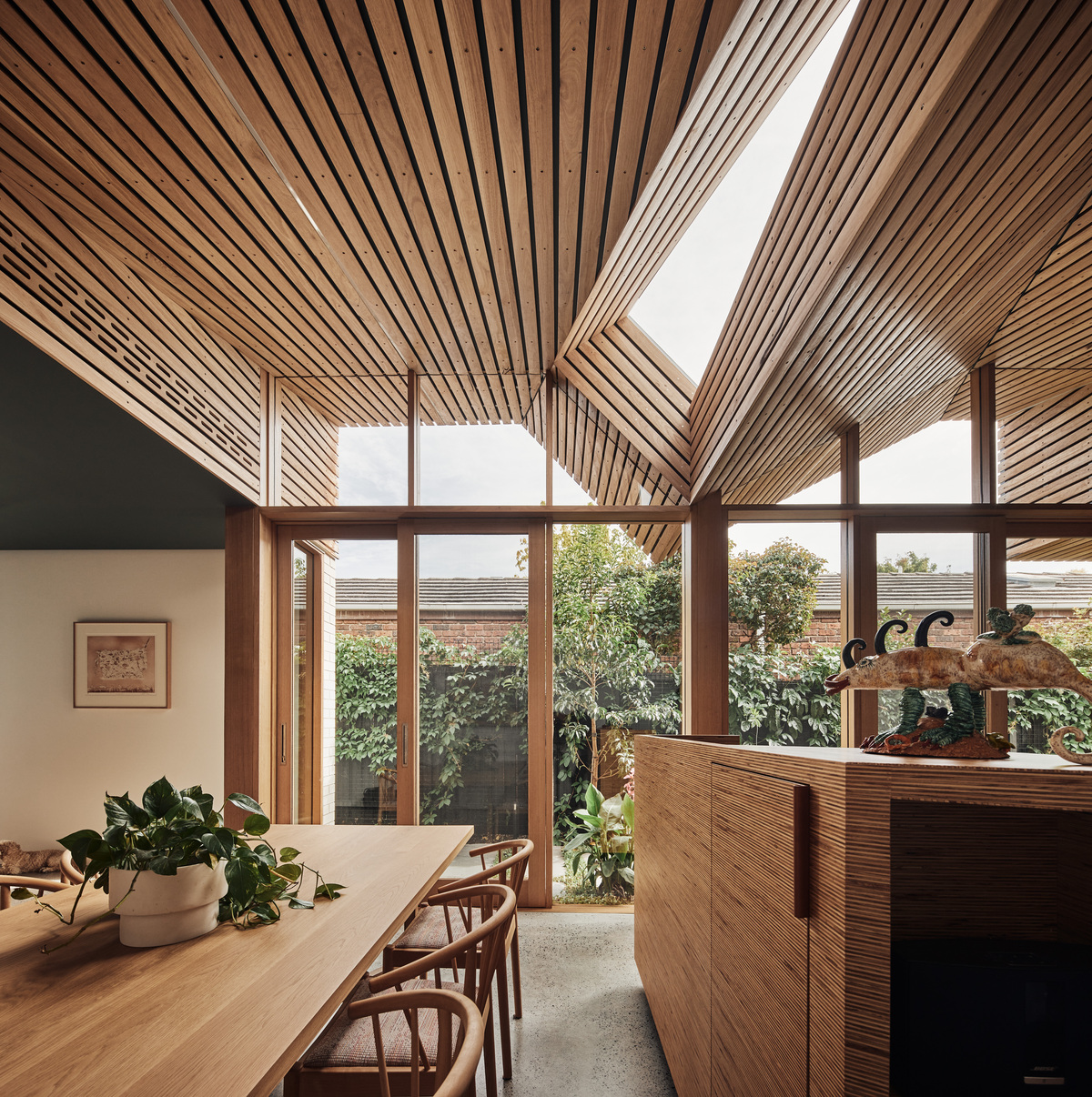
Beyond, a striking rippled ceiling in silver-top ash defines the principal volume of the new extension. Folded forms crank to capture northern light above the neighbouring brick boundary wall, while raking low along the southern boundary to allow neighbours the same privilege.
Junctions were meticulously detailed to achieve a restrained sensibility.
A ‘springing point’ anchors the ceiling arrangement, with a triangular skylight drawing in morning light and creating strong definition between dining and lounge volumes.
An angular ply unit sits in sculptural dialogue below, housing utilities in a refined and elegant gesture, reinforcing the definition between spaces while maintaining visual connections.
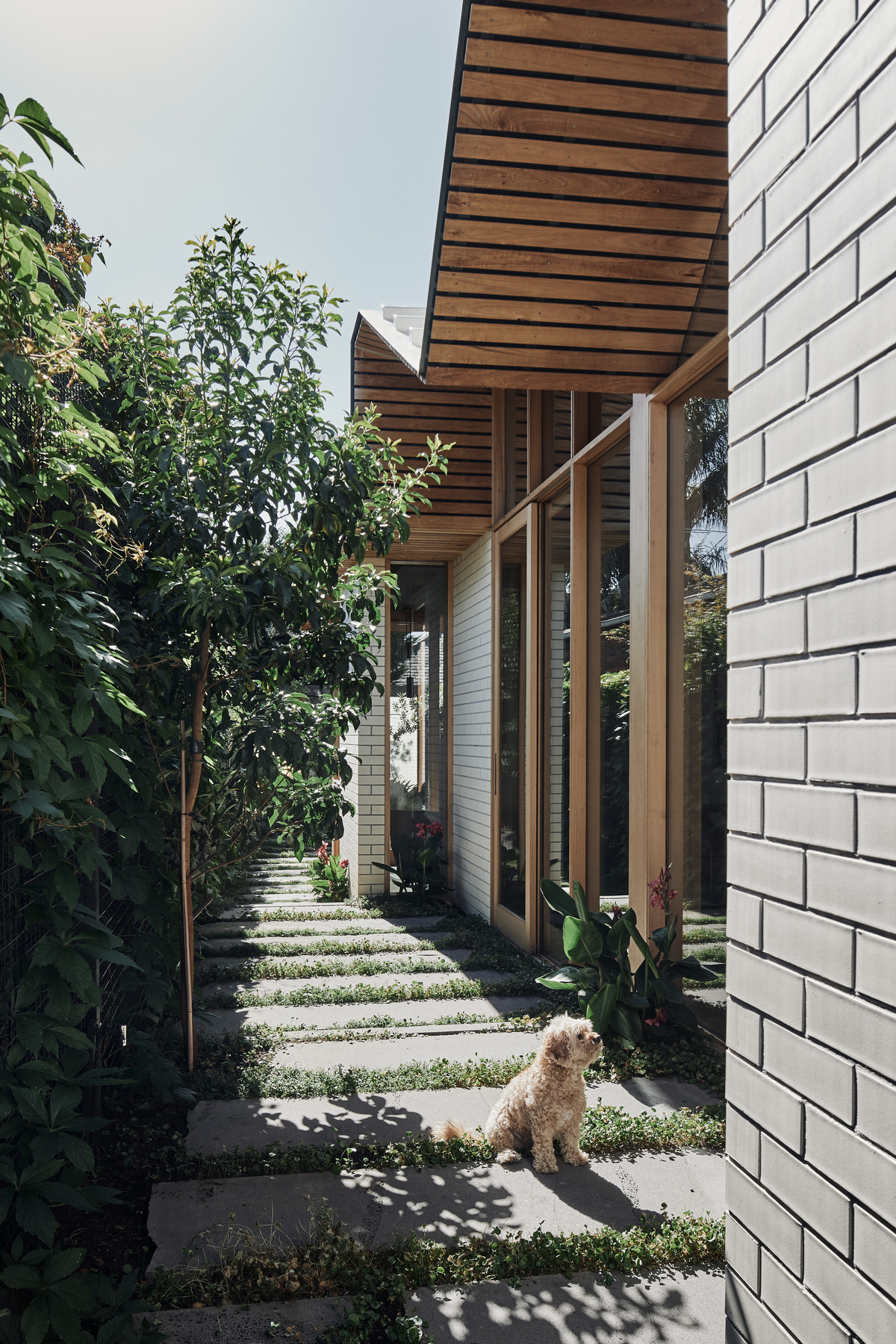
Operable glazing unites the living room with a narrow, stepped garden along the northern edge, extending the interior footprint to give a sense of scale and generosity.
The rippled timber ceiling projects along this spine, creating an inverted pathway in the sky.
A wide sliding door opens to the main bedroom, offering views through to the eastern garden.
Here, a mirrored shed reflects the lush textures of the stepped garden and rippled ceiling, appearing to span the full length of the site.
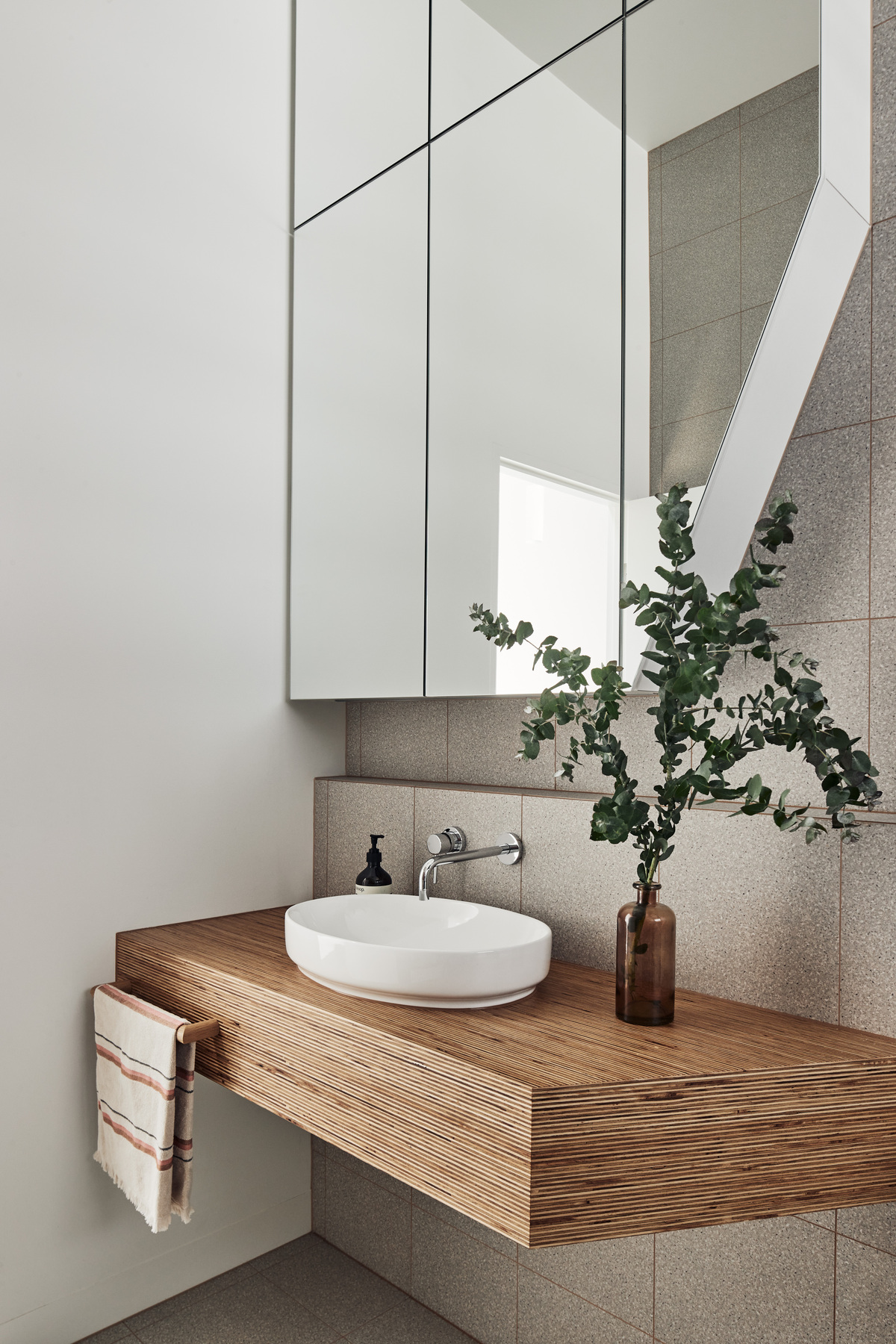
When the sliding door is closed, the experience of the master bedroom becomes intimate and secluded. A walk-through robe leads to a tactile ensuite finished in eucalypt tiling, responding to the natural and calming tones of nature, washed in morning light.
Ripple House is designed around the core tenets of sustainable building practice.
The concrete slab provides effective thermal mass by absorbing northern sun, while the canopies offer shade to the interior in the hotter months.
The walls and ceiling are highly insulated, while windows are double-glazed, effectively controlling thermal and acoustic performance.
Natural and locally sourced materials are favoured, including silver top ash, ply, laminate, timber and brick.
Furniture is Australian designed and made, while interspersed with vintage pieces.
The rippled ceiling combines energy-conscious LED strips, animating the geometry with lines of light, transforming the impact of the ceiling between day and night.
The house expresses a continual play between pragmatics and the creative reverberations between light and site.
Ripple House was designed by the FMD Architects team around the core tenets of sustainable building practice, reducing running costs over the lifetime of the project.
The concrete slab provides effective thermal mass by absorbing northern sun, while the canopies offer shade to the interior in hotter months.
The walls and ceiling are highly insulated, while windows are double-glazed, effectively controlling thermal and acoustic performance.
Cost effective, carefully detailed materials are favoured, including silver top ash, ply, laminate, timber and brick.
The rippled ceiling combines economical LED strips, animating the geometry with lines of light, transforming the impact of the ceiling between day and night.
Project Details
Project Size – 160 m2
Site Area – 365 m2
Completion Date – 2020
Building Levels – 1
Project Team
Architecture
FMD Architects
FMD Architects is an architectural practice with extensive experience in architecture of varying scales, types and budgets.
The core work of the practice is boutique commercial, hospitality and residential work.
The focus on specific projects enables a high level of client service as well as an intense design process with rigorous detail.
Photography
Peter Bennetts
Peter’s work regularly features in the Australian publications Architecture Australia, Artichoke, Belle, Inside, AR, Monument, inside, and Vogue.
He is a frequent contributor to Wallpaper, Frame, Mark, Dwell, Domus, Casabella, and other international publications too.
Peter’s photography has appeared in numerous books including four monographs and the two volumes of the Phaidon Atlas of Contemporary World Architecture.
Peter’s architectural images have been described as having “a remarkable crystalline stillness” and he is known for his “straight-shooting” style of architectural photography, focusing on the formal, material and atmospheric qualities of a project.
Photo Gallery
Click on a thumbnail image to enlarge.








Design © 2021 FMD Architects. All Rights Reserved.| Images © 2021 Peter Bennetts. All Rights Reserved.
The Builtworks Quest
At Builtworks, we’re on a multi-year quest to document, showcase, and spotlight the best of Australia’s built environment.
That’s why we’re creating this comprehensive online archive and educational resource that showcases a diverse and eclectic range of project types and scales.
Together with showcasing older exemplars of enduring merit, we spotlight and celebrate the very best new and recent additions to Australia’s built environment.