

CplusC Architectural Workshop’s brief was for a small weekender.
So care was taken to create a series of spaces which would be comfortable year-round.
The aim was to increase the number of places in which one could sit and enjoy the inspiring surrounds.
The paved courtyard faces due north and soaks up the winter sun.
Paved capping at a comfortable seat height surrounds the courtyard, fireplace and pond.
Similarly, built-in seating in the living areas and on the front deck were included.
The 12 hectare site is bounded by properties on two sides, and the river and hills.
A tiny timber cottage existed in a derelict state, virtually unseen due to the overgrowth.
It was clear the position of the cottage was the natural place to build, and it was above the high flood level.
The site had existing embankments to create a level site, around which the cottage and a slab hut sat.
The decision was made early to work within these boundaries and restore the site; this allowed the retention of the massive sandstone fireplace and slab hut as elements of the design.
The plan of the house is a variant of the gun-barrel plan; the structure is continuous throughout, as is the roofline and ceiling.
Sleeping lofts at either end enclose a deck and bathroom / laundry below at either ends.
The fireplace and joinery unit divides the living area from main sleeping area, and provides storage for both.
The kitchen faces this unit, and a communal dining / living area which opens to the courtyard.
Built-in seating bays on the southern wall double as beds, and combined with the lofts, boost the accommodation to a possible eight people.
The planning of the living areas was considered in conjunction with the planning of the ‘courtyard’, and great care taken in how the building stepped down and connected with the ground.
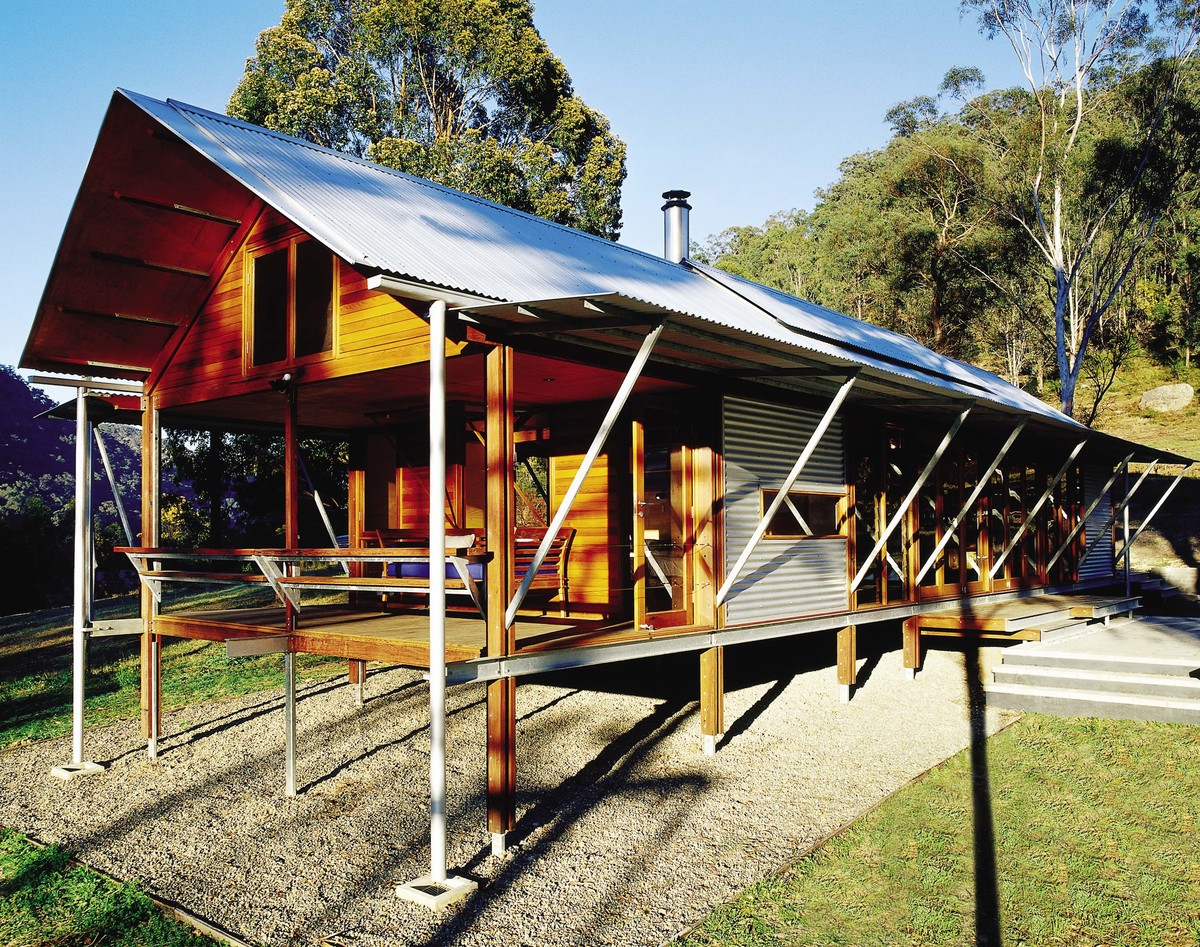
The construction technique of the building allowed it to look and feel elevated, a built intervention within the environment.
The mass of the courtyard and stone fireplace grounds the work, contrasting and enhancing the light steel framing of the awning, and the sharp edges of corrugated roofing.
From the approach, the elevated structure can be seen clearly, and gives the impression that the bolted connections could be undone and it could float away.
The spectacular site allowed the building to open up in all directions, and frame the numerous views down the valley and to the glowing rock escarpment.
Sliding bi-fold doors and windows open the living area to the courtyard, and encourage cross ventilation.
Although the star of the show is undoubtedly the natural surrounds, emphasis was given to the interior, and the intention of creating a comfortable, inviting and generous space.
Given that the house is primarily for two, separate bedrooms are not required; this allowed a continuous volume inside, giving the small house a deceptive sense of space.
The interior materials are predominantly timber, and create a warm, innately natural atmosphere.
Traditional materials of rural Australia have been used in conjunction with modern building techniques and systems to create a contemporary weekender, with an awareness of its environment, history and place.
The materials chosen by the CplusC Architectural Workshop team were informed by the acquisition of the old St Alban’s Bridge ironbark, which they chanced upon on one of their early site visits.
Galvanized steel sections welded on site were chosen to aid in the stability of the structure, its resistance to termite attack, and in connections between structural elements.
The palette of materials was expanded to include hoop pine plywood for joinery, wall and ceiling lining, Karri flooring and decking, and cedar doors and windows.
With the exception of the flooring, all elements were pre-fabricated to aid in erection and possible disassembly.
Clear finish oils were used throughout, which showcases the timbers characteristics and allows for a graceful aging process.
Considered lighting was critical to stressing the natural beauty of these materials.
All timbers except for the cedar are Australian, and are either recycled, plantation-grown, or from managed forests.
Project Team
Architecture
CplusC Architectural Workshop
Founded in 2005, CplusC specialises in designing and delivering site specific architectural projects. Their designs are driven by a commitment to understanding their clients’ requirements and the local climatic conditions to develop unique design outcomes.
Craftsmanship, comfort, sustainability and practicality are central to each and every design. The CplusC team enjoy examining preconceptions and interrogating assumptions to find better ways of living, resulting in lasting architecture.
They have a wide variety of professional experience spanning design, approvals and construction, ensuring architectural ideas are realised through construction.
Photography
Adam Craven
Connect with Adam on Linkedin.
Photo Gallery
Click on a thumbnail image to enlarge.



Design © 2020 CplusC Architectural Workshop. All Rights Reserved.| Images © 2020 Adam Craven. All Rights Reserved.
The Builtworks Quest
At Builtworks, we’re on a multi-year quest to document, showcase, and spotlight the best of Australia’s built environment.
That’s why we’re creating this comprehensive online archive and educational resource that showcases a diverse and eclectic range of project types and scales.
Together with showcasing older exemplars of enduring merit, we spotlight and celebrate the very best new and recent additions to Australia’s built environment.