

Suttons Beach is a sandy, gentle-water, and patrolled beach on the Redcliffe Peninsula in the Moreton Bay Region, just north of Brisbane.
It’s popular with local families with young children who enjoy the beach.
And people from across the region rate this scenic location highly too with many from Brisbane visiting the area, usually traveling by road across the viaduct known as the Houghton Highway.

Suttons Beach and the park along the foreshore are a picturesque and well-maintained public realm that delivers a lot of community value, including being home to the Redcliffe Surf Lifesaving Club.
Their popular nippers program is held at Suttons Beach every Sunday.
But there was trouble brewing in paradise.
Someone revealed that the Council was about to close public access to the Suttons Beach Pavilion buildings on the basis that they were unsafe.

That meant that the cafe tenant’s lease was not being renewed.
They had to leave.
And the demolition of the buildings was imminent.
So hundreds of angry residents pulled on their battle jackets, fired up the tiki torches, and sharpened their pitchforks.
OK, so it wasn’t exactly like that.
But they rampaged into Facebooklandia.
And started campaigning against the move.
“Hey Council, we know these bulky, shabby, and faux buildings don’t have any heritage value, and they might be falling down, but hands off OK…we love ’em!”
Many local residents understandably hold nostalgic memories of their interactions with this place.
Long-standing buildings like the Pavilion house a huge inventory of memories for the tens of thousands of people who have interacted with them over decades.
From big events like getting married in the rotunda…
… to the simple pleasures of snogging a dripping rum and raisin ice cream on a summer Sunday arvo…
…or smashing a furtive bottle or two of Gala Spumante with your underage mates on a Friday night…
…the collective community memory bank of this place has an emotional value.
The fact that elements of the community would conflate their treasured memories of a place with a constructed object like the Pavilion buildings, and become indignant when the extinction of their memory bank is threatened and their nostalgia disturbed, should surprise exactly no one.
People sense the loss of buildings like this in not just a cognitive way, but in a visceral, physical, and personal sense too.
It’s not that these visually assertive, rather jarring, ‘could do better’ buildings in and of themselves are what people care about most.
It’s the memories they hold.
And the amenity they provide.
When news of the Council’s intentions first became publically known, the only undertaking they made in response to the community’s disquiet was that if the buildings had to be demolished, then the site would be re-grassed and food trucks permitted to trade there whilst Council worked out what, if anything, was to follow.
Instead of supporting the proposal as a reasonable interim step, many residents imagined secretive, duplicitous, self-interested, and inept politicians taking away their much-loved asset, with no firm plan to ever replace it with anything good.
So politicians of all stripes felt the sting of the lash.
Perhaps if Council had instead offered for community consideration this Frank Gehry-inspired master plan, they’d have had a win.
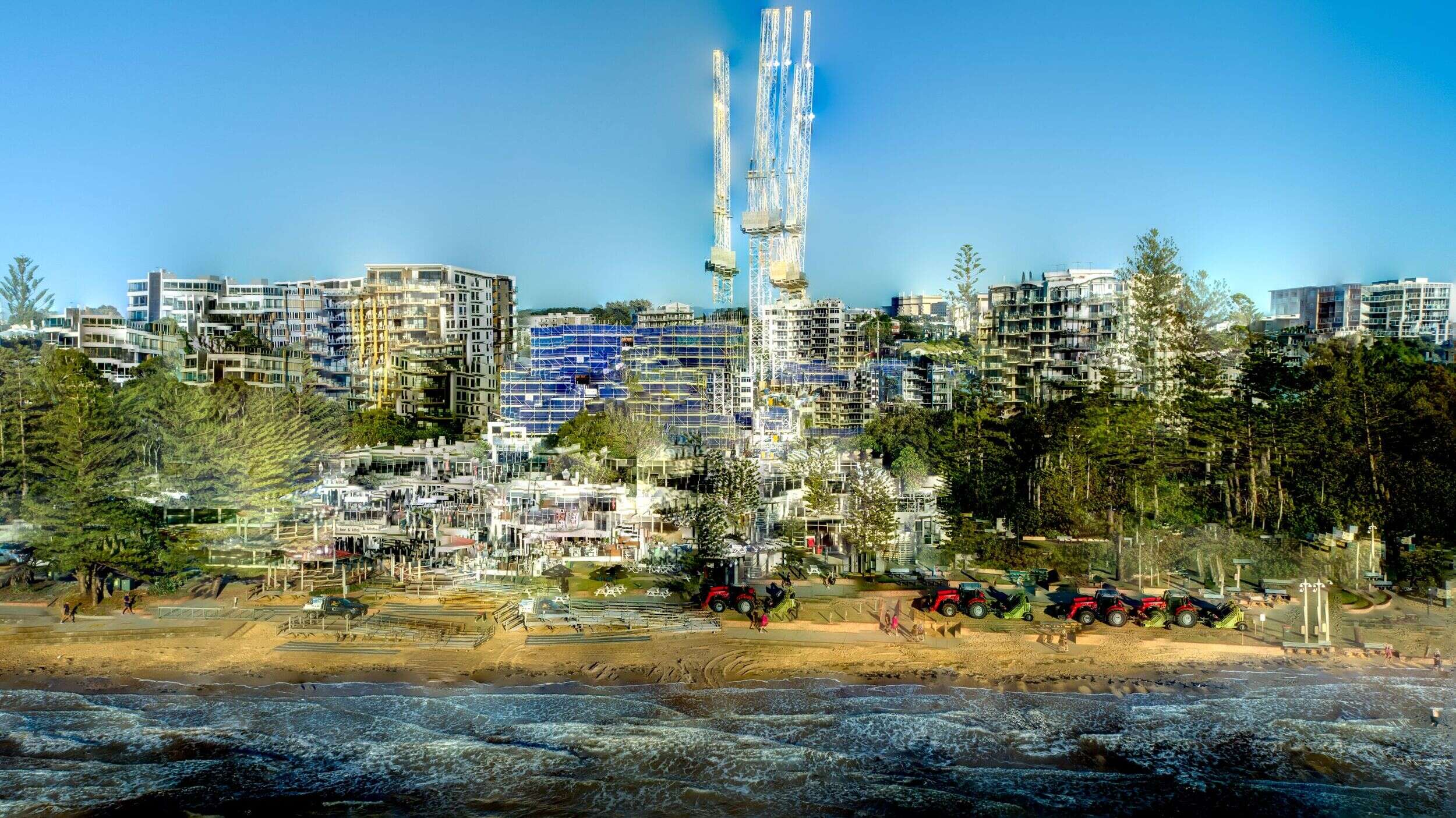
This worthy scheme contains expansive and layered meanings where objects melt into shimmering shapes and buildings take on amorphous, distorted, and flattened forms.
Given this outstanding proposal, surely the community would have dropped their weapons and been happy at last?
No?
Yeah, maybe not.
So faced with growing community agitation and organized resistance, Council scrambled to respond and:
- Commissioned a community survey that secured responses from about 2,000 residents.
- Commissioned independent consultants to undertake extensive testing of the buildings.
- Promised to release the consultants’ reports and actively engage with the community again before any major steps are taken.
The next major decision Council will take will be determining if the pavilion buildings, or any part of them, can be reasonably saved.
But whatever happens, certain expectations are destined to remain unfulfilled.
So there’ll be more hand wringing, foot shuffling, finger-pointing, and gnashing of teeth before it’s done and dusted.
Related Resource
Listen to this Builtworks podcast episode where architect Melonie Bayle-Smith explains the importance of effective community consultation when proposing changes to the built environment in Kirribilli, North Sydney.
The Builtworks Quest
At Builtworks, we’re on a multi-year quest to document, showcase, and spotlight the best of Australia’s built environment.
That’s why we’re creating this comprehensive online archive and educational resource that showcases a diverse and eclectic range of project types and scales.
Together with showcasing older exemplars of enduring merit, we spotlight and celebrate new and recent additions to Australia’s built environment.