
Schools across Australia face a common challenge.
Most are arranged in a traditional campus arrangement of disconnected, inflexible, internalised spaces.
But what’s needed today is an adaptable, coherent, learner-centred environment that prioritises student agency and strengthens community connections.
So since 2015, Ringwood Secondary College, a single-campus school of more than 1,600 students in Melbourne’s outer east, has been working closely with ClarkeHopkinsClarke Architects to masterplan and deliver transformative facilities, in stages over time.
The gradual pace allows time for new approaches to learning and connecting with the local community to be tested, embraced, and sustained.
Before his recent retirement, former Principal Michael Phillips explained, “A key challenge of the project is replacing a mish-mash of buildings and relocatable stock with no overall coherence.”
Stage 1 established a new architectural language for the College by introducing a purpose-built Junior School Building.
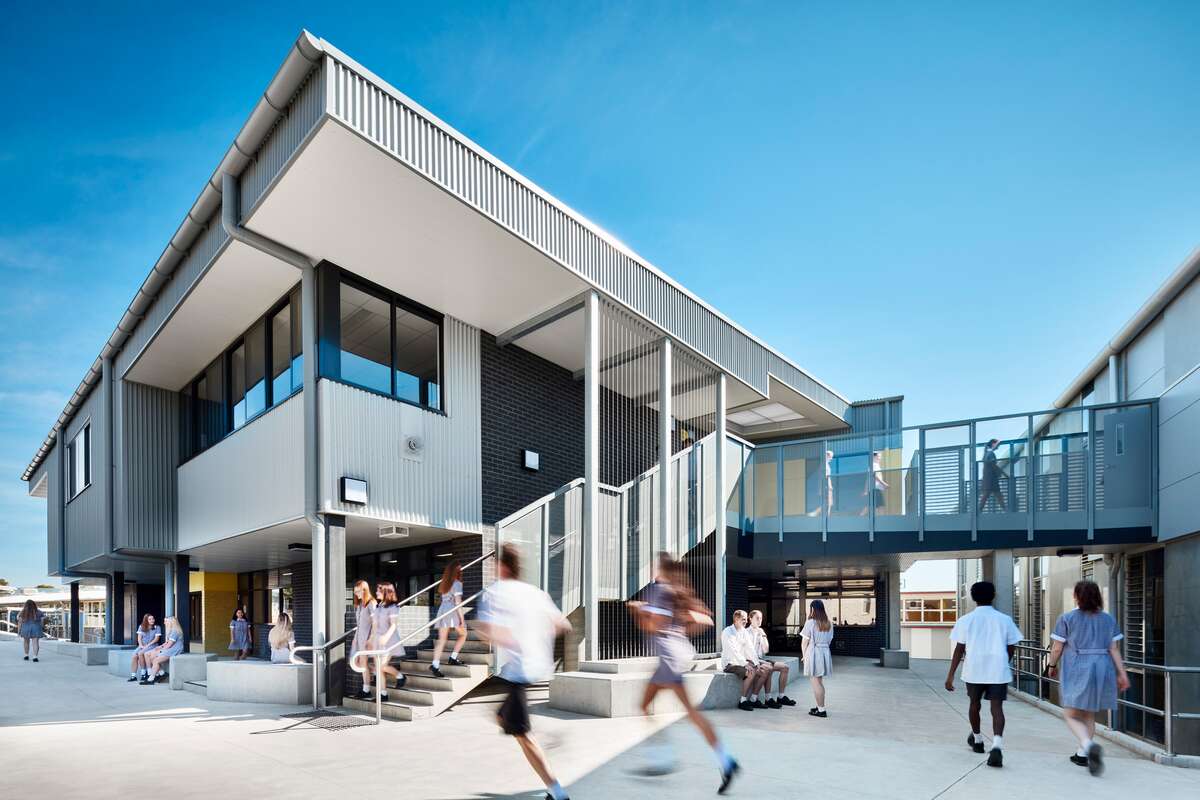
Stage 2 augmented that approach with a contemporary split-level learning hub for senior students.
The students chose an Indigenous name for the building, which was endorsed by the Wurundjeri Woi Wurrung Cultural Heritage Aboriginal Corporation.
Yanna Mudjirr means stepping stones.
This reflects a core purpose of learning in the building and relates exceptionally well to transitions and pathways for students.
At ground level, the Senior School Building features learning spaces separated by sliding glass walls, which can be reconfigured for collaboration or spill out into a versatile central space featuring a kitchenette, study nooks, and tiered seating.
A gallery on the upper level overlooks the central Study Centre and includes a casual break-out area, Media, and ICT rooms.
A bridge on the upper level connects through to Ringwood Training Centre and allows for sharing of facilities.
ClarkeHopkinsClarke Architects Education Partner Wayne Stephens says the new facility “introduces a young-adult environment that maximises choice for senior students.
The site was extremely tight and surrounded by buildings and services,” he says.
Despite that, the design features generous volumes, uplifting spaces, high ESD values, a sense of openness and transparency, clear sightlines, and lots of natural light and ventilation.
Our builders Lloyd Group did an exceptional job with construction.”
Project Architect Karin Allen says the interconnected learning spaces with glazed acoustic panels can open up for co-teaching, out for external learning in shaded outdoor settings, or inwards into the light-filled central core of adaptable shared spaces.
“These can be easily configured for large and small groups, formal and informal learning, collaboration, self-directed learning, presentations, and events,” she says.
“This means there’s flexibility for both explicit instruction and collaborative learning. Detailing like green screens in the media space and a custom ICT fit-out deliver outstanding specialist areas.”
A standout of Yanna Mudjirr is an informal, skylit study space overlooking the central void.
Decorative screening, natural light, flexible bench seating, and endless power points make it a popular place for students to connect or engage in self-directed learning.
Another highlight is the specialist ICT spaces and facilities, created to an exacting brief.
These form a new community hub used outside school hours by Ringwood Training.
Previously, senior students accessed Ringwood Training’s vocational education facilities via a circuitous route.
The new design introduces an upper-level bridge that links both facilities and literally elevates this important community partnership in the minds of learners and educators.
The easy two-way flow of students between both facilities enables after-hours use of state-of-the-art ICT facilities by the Ringwood community.
It allows senior students to move seamlessly between VET and VCE learning.
“ClarkeHopkinsClarke Architects creates learning places where our teachers and students increasingly feel part of a community of learners,” said former principal Michael Phillips.
“Learning transitions from junior to senior school are no longer a theoretical construct. Teachers and students now operate beyond the static, outdated one-space and one-teacher models. We continue to go deeper, open the classroom doors, and look forward to future possibilities enhanced by a fit-for-purpose built environment.”
Project Awards
2021 LEA Vic Chapter People’s Choice Award.
2022 Learning Environments Australasia Award for Best New Individual Facility under $8M.
Project Team
Architecture
ClarkeHopkinsClarke
The three founders of ClarkeHopkinsClarke are RMIT Architecture graduates Jack Clarke, David Hopkins, and Les Clarke.
Chalk and cheese and unlikely friends, but true believers in the power of architecture to connect people and communities, fulfill needs, and enrich lives.
Photography
Rhiannon Slatter
Rhiannon is well-established Melbourne-based fine art and architecture/interior photographer.
Photo Gallery
Click on a thumbnail image to enlarge it.
Design © 2022 ClarkeHopkinsClarke. All Rights Reserved.| Images © 2022 Rhiannon Slatter. All Rights Reserved.
The Builtworks Quest
At Builtworks, we’re on a multi-year quest to document, showcase, and spotlight the best of Australia’s built environment.
That’s why we’re creating this comprehensive online archive and educational resource that showcases a diverse and eclectic range of project types and scales.
Together with showcasing older exemplars of enduring merit, we spotlight and celebrate new and recent additions to Australia’s built environment.