
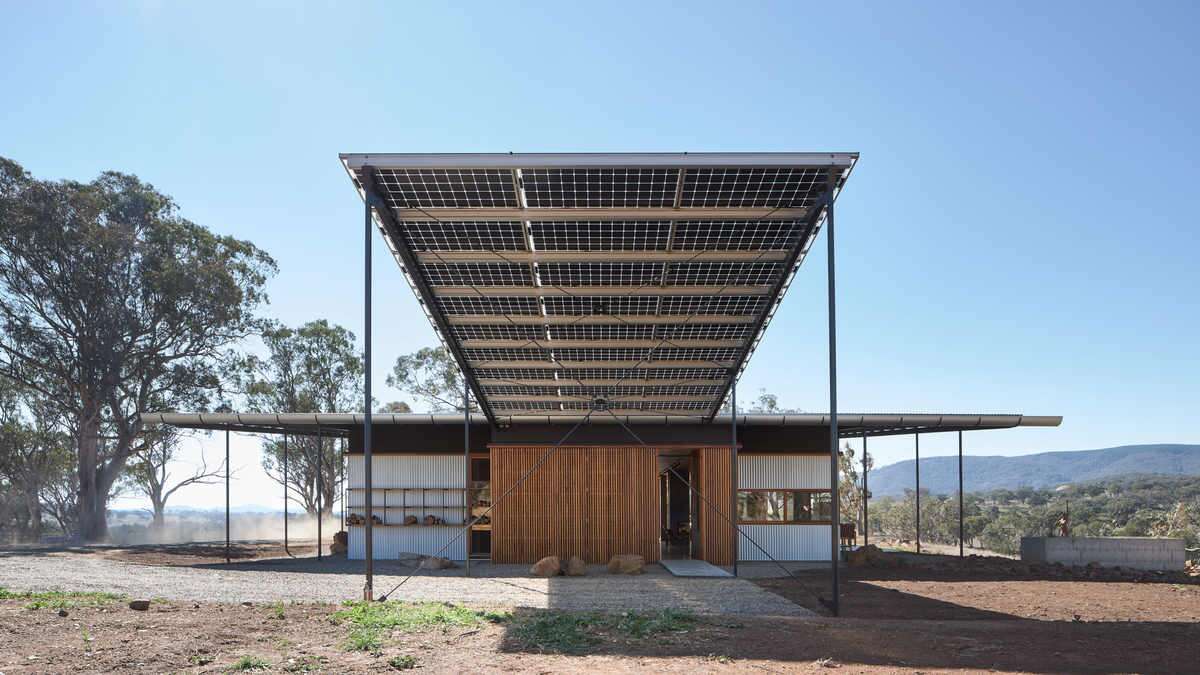
Alexander Symes Architect was commissioned to design a three-bedroom home on a bull farm located around 50mins south east of Tamworth.
Tamworth is a city in northeast New South Wales known for the annual Tamworth Country Music Festival which draws big-name international acts.
The client wanted a home that celebrated the site’s panoramic views with a focus on two impressive rock formations known as hanging rock and yella-rock.
This off-grid home had to be robust, practical and low maintenance.
It had to be capable of entertaining family and friends with an outdoor firepit and opportunities to display artwork.
The design that Alexander and their client settled upon was inspired by the iconic Australian Akubra hat.
The client had pre-selected the site for their new home atop a gently sloping hill.
It sat amongst a grove of eucalypts, with the site falling sharply away to a dry creek bed in the east.
From this vantage point, the clients pointed out the vistas they wanted to appreciate in their new home.
There was “yella-rock” to the south and “hanging-rock” to the east.
And a unique vista north through the grove of native trees.
Plus a vista west over the dusty bull paddocks to the rolling hills beyond.
In short; stunning 360-degree views.
But there was a problem; how to create a low-energy, thermally comfortable home that celebrated these all-round views.
Alexander Symes recalls, “The Station Manager was curiously watching on, wondering what this city-slicker architect was going to do when I asked him for his Akubra hat.
Placing it upside down, I started to explain the concept of the “upside down Akubra house”.
The idea was, a single large-scale roof form, much like the brim of the Akubra hat, overhanging the house below.”
Alexander explained that his design concept ensured the roof would block out all the summer sun, yet allow in the winter sun to warm the central thermal mass.
That would form the spine of the home as well as catch rainwater to run the house, all with a functional home underneath celebrating views in every direction.
So it was from that meeting that the Upside Down Akubra House was born; a house with a roof that is 2.5 times the size of the building footprint, a home that generates and stores all its own energy, collects enough water to run the house and treats its own waste.
These days, living off-grid is no longer a novelty.
But it’s a necessity in this remote location that’s subject to extreme weather conditions that include severe drought.
What makes this off-grid home unique however is how the technology has become part of the design aesthetic.
Celebrating the off-grid characteristics begins with the “humble” carport.
This carport stands 4.5m high at the tallest point and covers an area of 80m2.
So it’s far from the humble carport.
It is in fact a canopy of LG neon bi-facial photovoltaics.
That means that the solar cells are visible from the underside of the canopy, thereby celebrating the technology that powers the whole house.
Exposing solar panels like this communicates to visitors the eco-technologies that are integrated into the design.
And it educates all that encounter it on low environmental impact power generation options and the efficient use of energy.
These photovoltaics generate 8KW of power for the house.
They are integrated into clear glass modules that allow filtered daylight into the carport, maintaining a connection to the sky in what is typically a closed-off and dark space.
The entry to the home is also the introduction to the single 450mm diameter gutter that collects all rainwater from the 560m2 roof.
This gutter channels all the rainwater from the roof to a single point from which the water free falls like a waterfall into a simple off-form concrete trough.
The trough acts as a filtration sump which feeds the 107,000-litre rainwater storage tank.
Australia is the driest inhabited continent in the world and rainfall is the lifeblood of Australia’s farming community.
By revealing a typically concealed process, it communicates the importance of collecting and storing water and encouraging its efficient use.
Setting aside the technical elements of the entry, the first glimpse of how the house has been nestled into the unique natural surroundings is revealed at the airlock front door.
The airlock is made up of two 3m tall blackbutt timber framed glass doors through which a clear view is created down the central off form concrete spine of the house.
The view through this spine terminates on the grove of native eucalypts that cluster on the northern side of the house.
This moment brings the natural environment into the house blurring the lines between the inside and the outside…an important theme throughout the house.
On stepping through the airlock, the home opens into the open-plan study, living, and dining areas.
The simplicity and openness of the space draw the eye to the impressive vista of Hanging Rock, framed by the 3m tall blackbutt double glazed sliding doors with high visual light transmittance.
The 3m tall sliders are flanked by a series of smaller horizontal windows that form a common datum line around the house.
These windows focus the view to the horizon and “yella-rock” beyond, connecting you to the landscape.
The use of double-glazed, high visual light transmitting glass throughout the house contributes to the thermal comfort of the occupants throughout the year whilst allowing a high level of natural light to flood into the home.
The central spine of the house contains the utility and service rooms and is bounded by a textured off-form concrete wall created from the imprint of the Zegoform reusable formwork solution.
This blank canvas offers a simple backdrop to the owner’s indigenous art collection which is displayed throughout.
Following this spine towards the view, you come to the open plan kitchen which flows seamlessly to the outside bluestone patio that wraps around the northern and eastern elevations.
The kitchen is anchored by the large island workbench which allows the communal preparation of meals and the coming together of friends and family.
The bluestone patio is ample in size.
It creates outdoor rooms that extend the inside out and provides additional opportunities to gather and feel connected to the land.
This is accentuated by the progressive view of Hanging Rock that is framed by the cantilevering corners of the roof that connect the internal living spaces to the outdoor rooms, coupled with the layering of the fire pit with the horizon, to create a dramatic backdrop to the main living spaces.
The west wing of the house contains modest bedrooms which have a low window-to-wall ratio to provide privacy, and most importantly, improve the thermal performance of these spaces in the harsh western sun.
The windows follow the line of the horizon framing the views across the paddocks to the escarpment.
This deliberate horizontal datum also slowly reveals the house to visitors as they approach the western driveway that wraps around the house.
The home is influenced by simple practical rural buildings which inform its metal, timber, and concrete material palette, responding to the client’s brief for a robust and practical house.
This manifests itself in a house that is “dematerialised”, with exposed joinery, polished concrete floors, and exposed concrete walls.
The joinery throughout is open-shelved black steel and blackbutt decking boards with pine lining boards for the walls.
The pine boards also line the ceilings throughout and are used in the utility spaces to accentuate the view upwards to the operable skylights.
These skylights bring in natural ventilation and enable a connection to the sky in these inward-facing rooms.
The floor is polished concrete with an aggregate reflecting the land’s warm colours and the bush’s greens.
Integrated into the floor is in-slab hydronic heating and cooling.
That’s powered by onsite renewables and provides additional active heating and cooling as necessary.
The concrete floors together with the Zegoform concrete walls are exposed in winter due to the pitched roof form and covered in summer when the sun is high.
This creates a large thermal mass through the house which provides natural warmth in winter and natural cooling in summer.
This simple palette continues to the exterior with the lower portion of the home clad in reflective zinculume custom orb which picks up the sun, illuminating the home in the landscape.
The upper portion of the façade is clad in monument matte mini-orb which makes the structure and roof recede, emphasising the floating “Akubra” roof.
This simple black and white exterior colour palette is broken up by blackbutt timber on the windows, door frames, and screening for the utility areas.
It provides moments of warmth which soften the exterior and nestle the house into the landscape.
To further manage the extreme temperatures during the year, the façade and roof are highly insulated and sealed with a high-performance water permeable membrane that increases air-tightness.
To assist in providing fresh air to all the rooms without losing or gaining unwanted heat, the ceiling void is fitted with a heat recovery ventilation unit which circulates fresh air to all the rooms.
A heat exchanger reduces energy losses.
Through the inspiration of the iconic Akubra hat, a simple yet modern farmhouse was created here.
This design by Alexander Symes Architect responds to extreme climatic conditions, has a light touch on the landscape, harnesses nature’s energy for sufficiency, and connects to its surroundings.
Key Products Used
- LG Neon bi-facial solar panel
- Zego Reform off form concrete walls
- Pyrolave worktops
- Colourbond custom orb and miniorb
- Ecooutdoor pacific bluestone
- Chazelles D1000 EPI fireplace
- Eziform gutter
- Proclima extasana water permeable membrane
- Stormtech strip drains
- Bigassfans ceiling fans
- Brink Heat Recovery Ventilation system
- Velux skylights
- Ozzi Kleen RP10 wastewater treatment system
- Viridian lightbridge insulated glass units
Sustainability Features
- Exposed insulated thermal mass shaded in summer and exposed in winter
- Heat recovery ventilated system
- Onsite wastewater treatment system
- In-slab Hydronic heating and cooling powered by onsite renewables
- Rainwater collection and 107,000 Litre storage
- Timber window and door frames with low conductivity
- High-performance double glass with high visual light transmittance
- Timber framing, glazing, joinery and linings
- Evenly distributed daylight
- Low air infiltration building envelope with water permeable membrane, tested and commissioned by blower door test
- Ceiling fans for thermal comfort in summer
Project Details
Project Size – 195 m2
Site Area – 314 hectares
Completion Date – 2019
Building Levels – 1
Project Team
Architecture
Alexander Symes Architect
Alexander Symes combines a scientific approach to sustainability with a practical and poetic understanding of crafting a building.
Structural Engineering
Ascent Consulting Engineers
ACE is a locally owned and operated business providing structural engineering services and solutions in the Blue Mountains and surrounds.
Construction
Blue Eco Homes
With a passion for building and the World Heritage area that is the Blue Mountains, Joe Mercieca had a vision to build sustainable quality homes, with minimal impact on the environment – both during construction and when occupied.
This was the catalyst for Blue Eco Homes.
Photography
Barton Taylor
Barton is an established commercial photographer specialising in architecture and design.
www.bartontaylorphotography.com
Photo Gallery
Click on a thumbnail image to enlarge it.
Design © 2022 Alexander Symes Architect. All Rights Reserved.| Images © 2022 Barton Taylor. All Rights Reserved.
The Builtworks Quest
At Builtworks, we’re on a multi-year quest to document, showcase, and spotlight the best of Australia’s built environment.
That’s why we’re creating this comprehensive online archive and educational resource that showcases a diverse and eclectic range of project types and scales.
Together with showcasing older exemplars of enduring merit, we spotlight and celebrate new and recent additions to Australia’s built environment.