
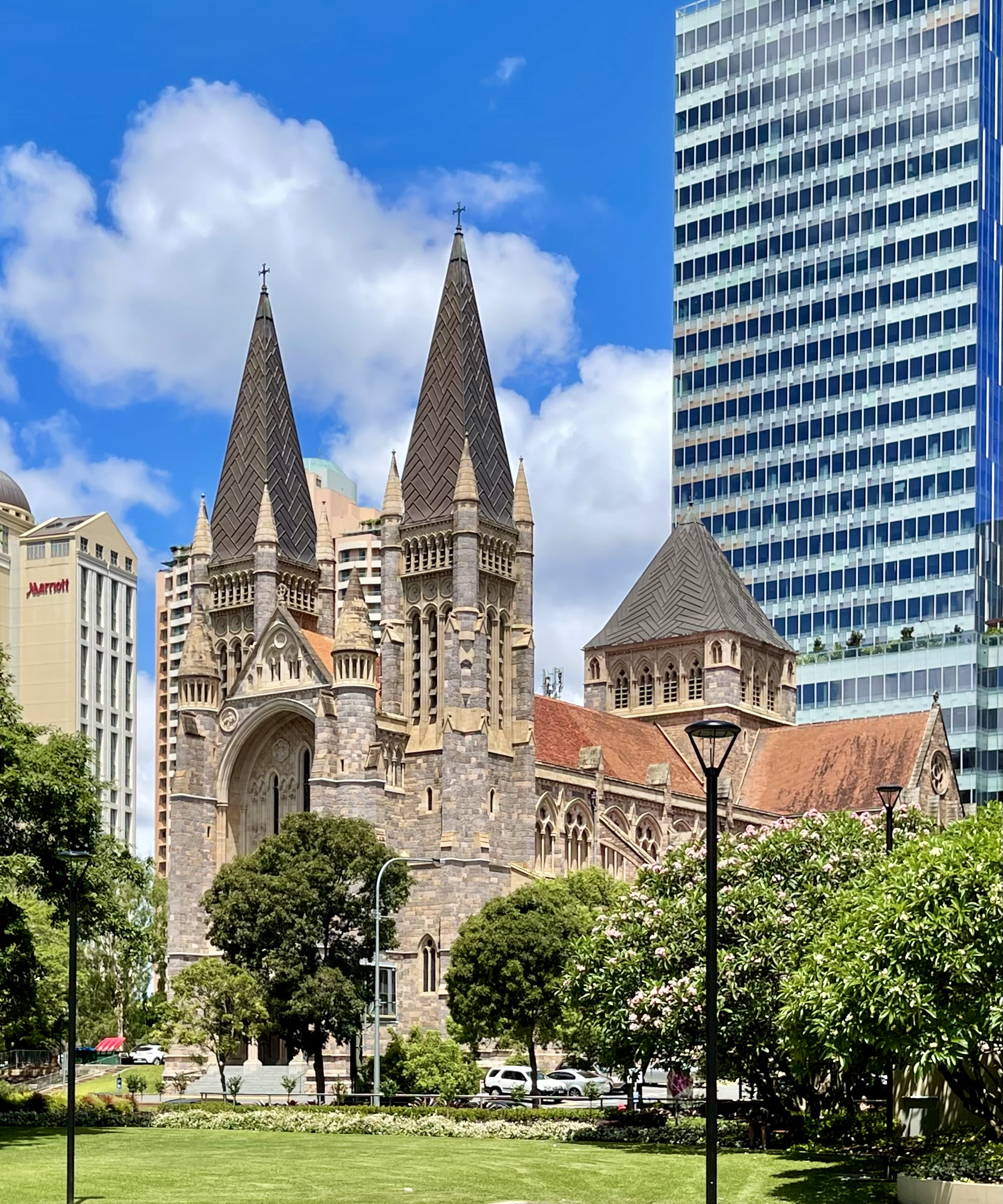
The impressive St John’s Cathedral is a a mixture of French and English Victorian Gothic Revival styles. It was designed by John Loughborough Pearson, one of England’s leading church architects of the late 19th century.
The design bears similarities to Truro Cathedral in Cornwall, also designed by Pearson.
Although similar, the architecture of St John’s is more decidedly French Gothic in inspiration.
And its floor plan is in the shape of the traditional Latin cross.
The nave has an aisle on each side, each of which is lined with sandstone columns and arches.
These provide support for Australia’s only stone-ribbed vaulted ceiling, which has a height of 18 m.
The high altar was designed by Frank Pearson, John Pearson’s son, in the Byzantine style and features red brown and grey-green marble slabs, each framed by a strip of decorative gold and multi-coloured mosaics.
Frank Pearson carried out the remaining design work after his father died in 1897.
The exterior is built of local porphyry and features terracotta shingle roofing.
Construction began in 1899 and took place in three stages.
The first stage (1910) completed the sanctuary, side chapels, transepts, and one bay.
The second stage (1968), supervised by the practice Conrad and Gargett, completed two bays of the nave and side aisles, towers, and the Ann Street frontage.
Further work commenced in 1989 and continued until 2009.
During this time the nave was extended and the two western towers and central tower were erected.
Get New Architecture Guides
Sign up below to be notified when new Architecture Guides are published so you don’t miss any.